Coldcard maker publishes postmortem: weak recovery phrases let thieves take about 1,779 BTC, and no device was hacked
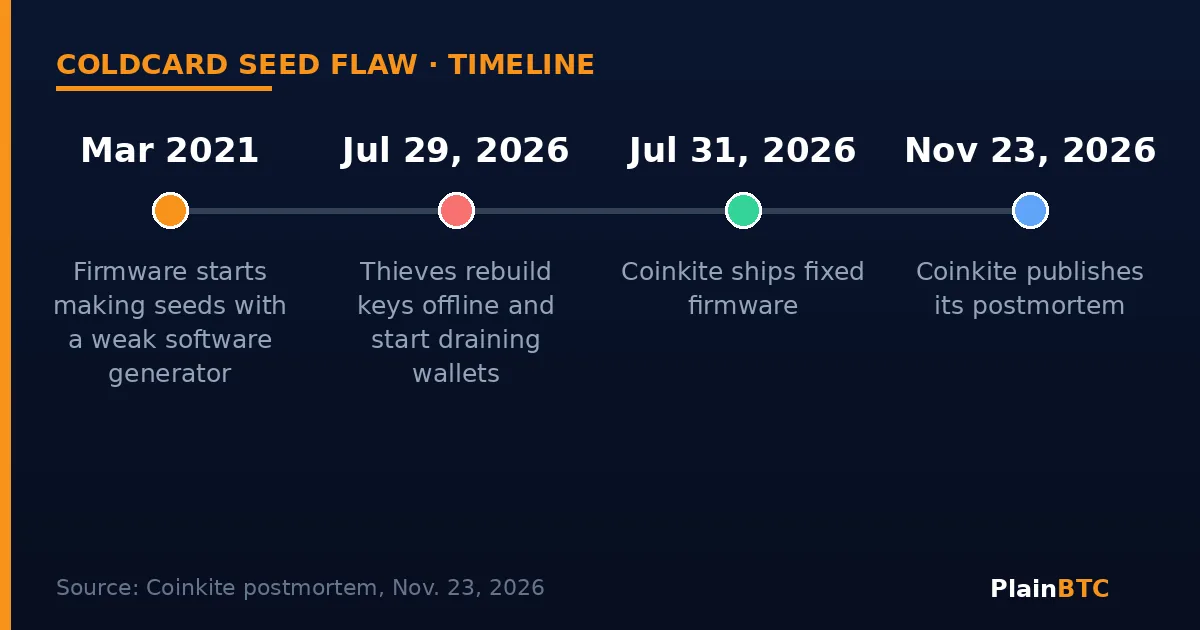
The company behind one of Bitcoin's best-known hardware wallets has laid out, step by step, how a hidden flaw put customer savings at risk for more than five years. Coinkite, the maker of Coldcard, published a detailed postmortem on Tuesday, Nov. 24, about the bug that made some of its wallets create weak recovery phrases. Thieves used it to rebuild private keys on their own computers and drain funds, starting on July 29, 2026.
"The losses are real and, for some customers, life-changing," Coinkite wrote. "We are sorry." The 18-page report, dated Nov. 23, is modeled on an NTSB accident report and says no device was remotely accessed or taken over.
Key takeaways
- From March 29, 2021, to July 30, 2026, Coldcard firmware created wallet seeds with a weak software random number generator instead of the device's hardware chip.
- Attackers recreated affected keys offline and began stealing funds on July 29, 2026. Galaxy Research reported 1,778.84 BTC stolen from more than 8,600 addresses.
- Coinkite fixed the bug on July 31. Its support team counted about 300 loss-related tickets, roughly 0.2% of its estimated user base.
- At least 15 independent reviews, including an AI-assisted one, missed the flaw.
- A firmware update does not repair an old seed. Owners of affected seeds must create a new one and move their bitcoin.
What went wrong
Every bitcoin wallet starts with a recovery phrase (also called a seed), usually 12 or 24 words. Those words come from a random number, and the whole security model depends on that number being impossible to guess. Coldcard was designed to draw it from a hardware random number generator built into its chip.
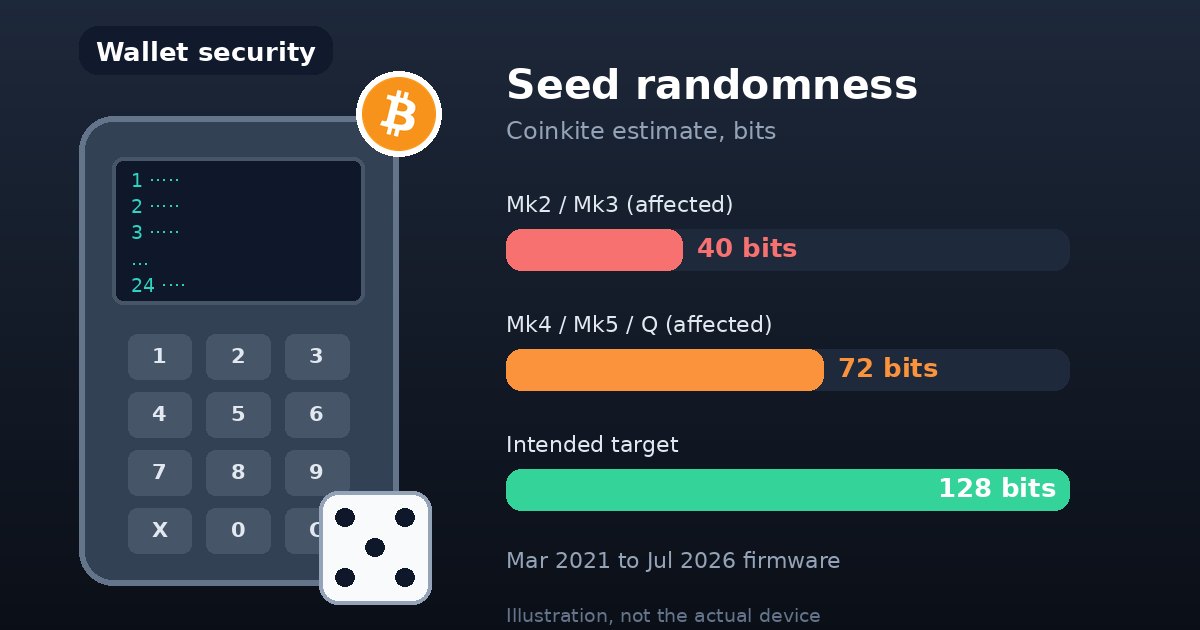
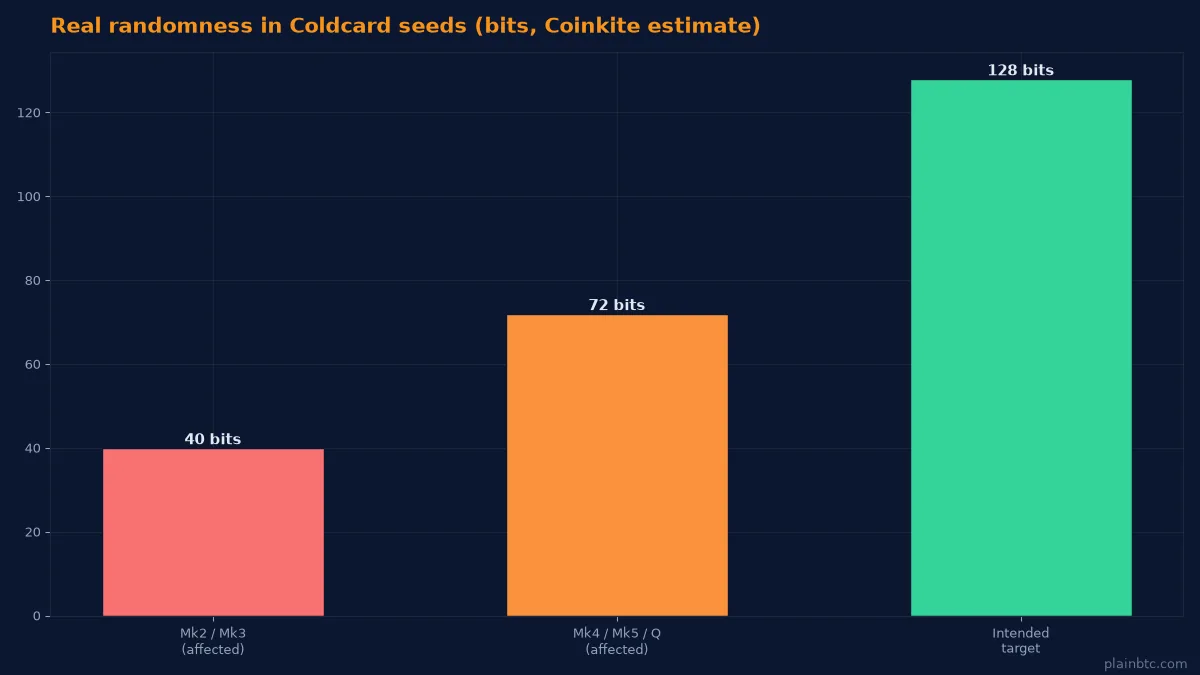
Because of a configuration and linking error, the firmware quietly used a simpler software generator from MicroPython, a programming toolkit, instead. The device still worked normally and printed normal-looking words. But Coinkite estimates the affected seeds had only about 40 bits of real randomness on older Mk2 and Mk3 models, or about 72 bits on the Mk4, Mk5 and Q, instead of the intended 128 bits. Each bit doubles the number of guesses needed, so the gap is enormous: a 72-bit seed is about 72 quadrillion (2 to the 56th power) times easier to guess than a 128-bit one.
How big is the damage?
The numbers depend on who is counting. In August, Galaxy Research reported 1,778.84 BTC stolen from more than 8,600 addresses, worth roughly $106 million at Tuesday's price near $59,700. Coinkite's own support review found about 300 loss-related tickets tied to roughly 240 customer accounts (the report says 242, the blog post 236), about 0.2% of its estimated users. Because Coldcard is self-custody, Coinkite can count only the losses people report, and it says "the true number is likely higher."
Coinkite has not decided on any compensation plan; the report lists that item as open. It also asked whoever holds the stolen coins to return them through [email protected], without promising immunity or payment.
Why nobody caught it
The postmortem lists at least 15 independent review and research efforts between 2021 and 2026, including two paid third-party product reviews. A two-month AI-assisted review this spring produced 85 findings but missed the bug. Coinkite says its checks confirmed the right generator existed in the code, but never verified that seed creation actually reached it. Who first found and exploited the flaw is still unknown.
What Coldcard owners should do
According to the report and Coldcard's security status page:
- Check whether your seed was created on affected firmware (for example, Mk4 and Mk5 versions before 5.6.0, or Q versions before 1.5.0Q).
- If it was, install verified fixed firmware, create a brand-new seed, back it up, and move your funds. Updating alone does not help.
- Seeds made with at least 50 fair, private dice rolls were not weakened.
- Never send seed words, passphrases or backups to anyone, including Coinkite, and treat unsolicited "recovery" or "compensation" offers as likely scams.
What it means for beginners
Self-custody gives you full control, but also full responsibility, and even well-reviewed devices can carry hidden flaws. Extra layers such as a strong passphrase or multisig can help. Many beginners instead start by buying a small amount on a large regulated exchange like Coinbase and learn about wallets before moving coins. Either way, only invest money you can afford to lose. This is not financial advice.
What to watch next
- Whether Coinkite announces compensation or help for affected customers.
- Any return of stolen bitcoin, or arrests tied to the thefts.
- More independent reviews of the fixed firmware, which Coinkite says are still needed.
New to wallets? Start with our guide to custodial versus self-custody wallets
Bonus Partner offer
Up to$100 in bitcoin
Get up to $100 in bitcoin on River- Create a new River account through this referral link.
- Buy at least $100 of bitcoin with cash from a linked bank account.
- Get $5 in bitcoin, then up to $100 as you buy more within 180 days. U.S. only.
Referral link, we may earn a bonus. Details
Not financial advice. This article is for informational and educational purposes only. It is not investment, trading, legal, or tax advice. Cryptocurrency is volatile and you can lose money. Do your own research and consider speaking with a qualified professional before making financial decisions.
Sources
- Coinkite: Our COLDCARD seed-generation postmortem is now public (Nov 24, 2026)
- Coinkite: COLDCARD Seed-Generation Incident Postmortem (PDF, report snapshot Nov. 23, 2026) (Nov 23, 2026)
- COLDCARD: Current security status and fixed releases (Nov 23, 2026)
- Coinkite: Technical deep dive into the entropy issue (Nov 2026)