Kraken's Krak opens a waitlist for U.S. credit cards with up to 4% bitcoin cashback, including one secured by USDC
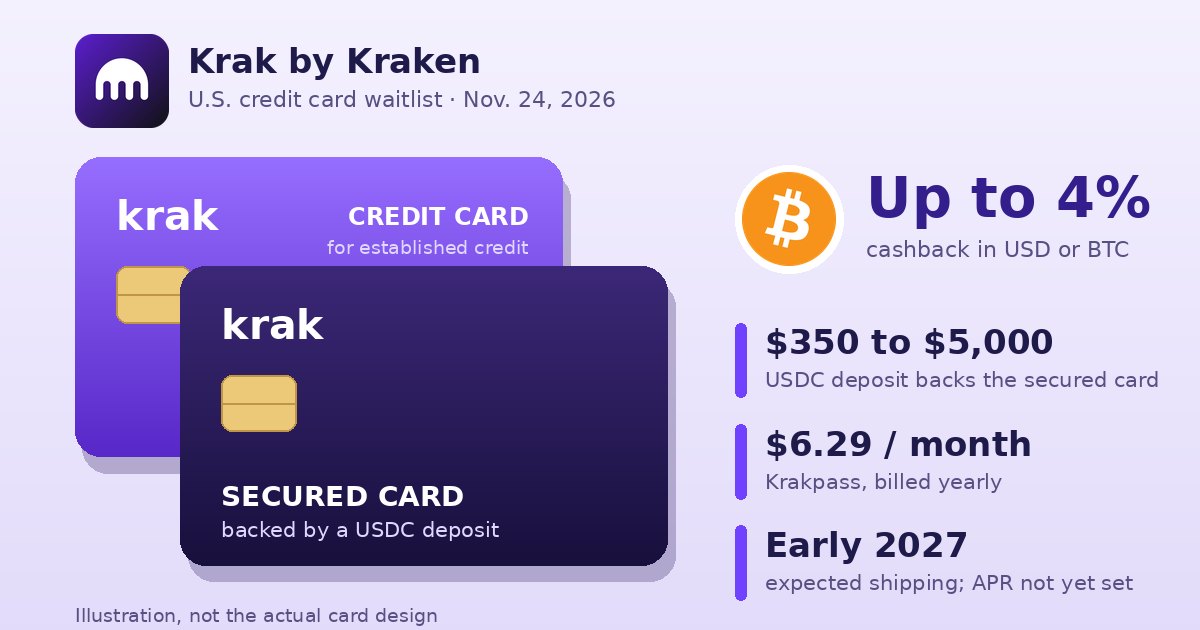
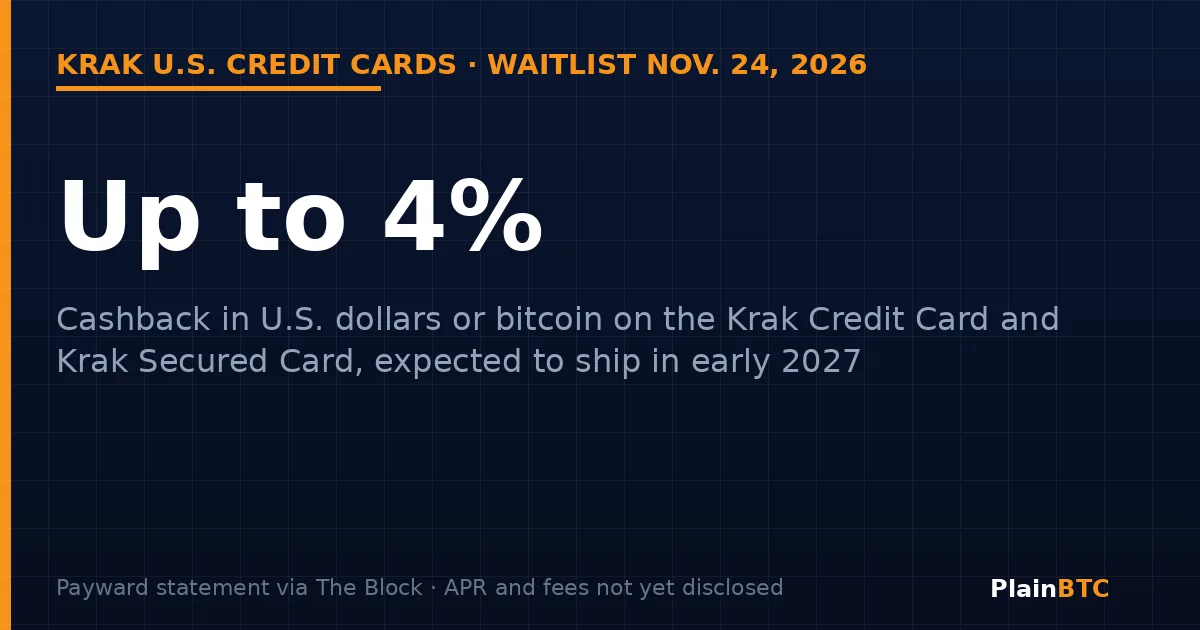
Kraken wants a spot in your wallet, not just your crypto portfolio. On Tuesday, Nov. 24, Krak, the money app run by Kraken's parent company Payward, opened a waitlist for two U.S. credit cards: the Krak Credit Card and the Krak Secured Card. Both are Visa Signature cards that promise up to 4% cashback, paid in U.S. dollars or in bitcoin, and both are expected to start shipping in early 2027, according to a company statement shared with The Block.
The cards arrive in a tough month for crypto. Bitcoin traded near $60,000 on Tuesday after a record month of ETF outflows, a reminder that a card paying rewards in bitcoin also hands you a small, volatile asset with every purchase.
Key takeaways
- Krak opened a U.S. waitlist on Nov. 24, 2026 for a standard credit card and a secured credit card. Shipping is expected in early 2027.
- Both cards offer up to 4% cashback in dollars or bitcoin, credited to your Krak account after a purchase settles, not as points.
- The secured card uses $350 to $5,000 in USDC, a dollar stablecoin, as collateral. That USDC can earn up to 4% APY through Krakpass.
- Both cards require Krakpass, which costs $6.29 a month billed annually, or nothing with more than $3,000 in monthly direct deposits.
- Interest rates (APR) and card fees have not been published yet. The cards will not be available in every U.S. state.
Two cards, two kinds of customers
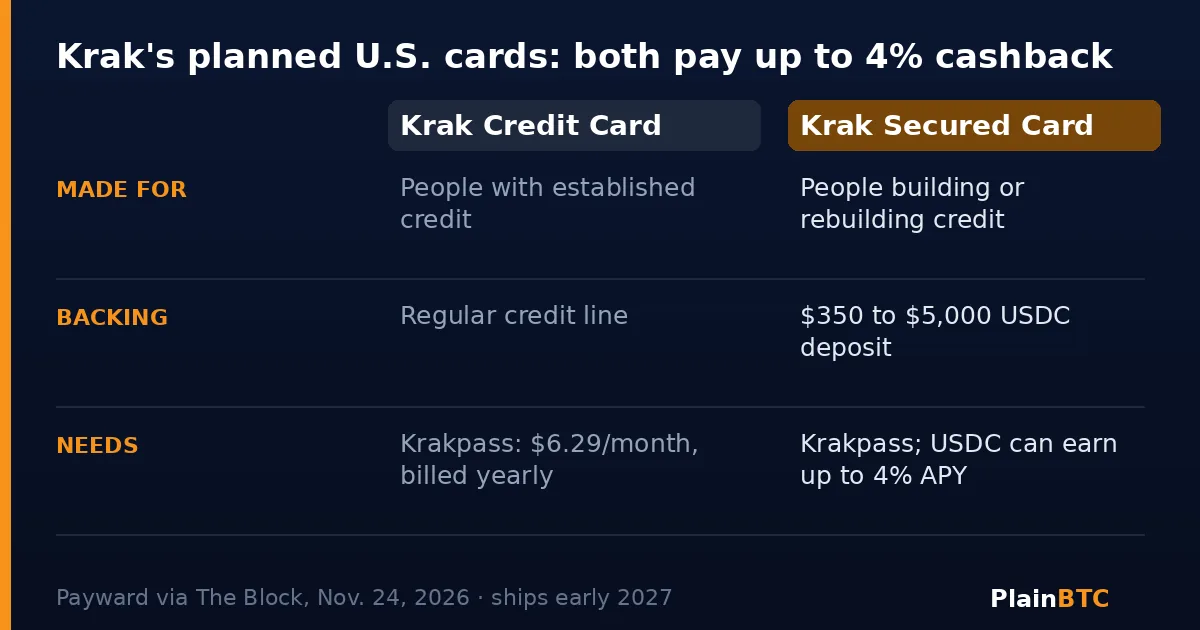
The standard Krak Credit Card is meant for people who already have an established credit history. The Krak Secured Card is aimed at people building or rebuilding credit, including what Krak calls crypto-native customers whose savings sit mostly outside traditional banks. Krak said it does not guarantee that using the card will create or improve a credit score.
A secured card works like a normal credit card, except you put down a deposit that backs your credit limit. With Krak, that deposit is USDC, a stablecoin designed to stay worth $1. Customers can deposit between $350 and $5,000 in USDC depending on the limit they want, a spokesperson told The Block. The coins stay in the customer's Krak account as collateral and can earn up to 4% APY through Krakpass, while purchases can still earn up to 4% cashback.
Cashback is credited once a purchase settles, in dollars or bitcoin. If you pick bitcoin, the value of that reward will rise and fall with the market after you receive it.
Who is behind the cards, and what it costs
First Electronic Bank will issue the cards under a license from Visa U.S.A., and Cardless, a fintech that runs branded credit card programs, will handle program management and servicing. Krak already sells a U.S. debit card that pays up to 2% cashback in dollars or bitcoin, with the rate depending on how much a customer holds across Krak and Kraken, according to Krak's support page. That debit card is not offered in New York, Maine, Massachusetts or Indiana.
Both new credit cards need a Krakpass membership: $6.29 a month when billed annually, or free for customers with more than $3,000 a month in direct deposits. Payward has not disclosed the interest rate (APR) or other fees and says full terms will come before the cards are issued. Payward co-CEO Arjun Sethi said the card industry has spent "decades pouring resources into increasingly complex rewards schemes instead of focusing on making credit products more accessible." Krak also cited a Morning Consult survey it commissioned in July: 30% of 2,001 U.S. adults said they do not own a credit card, and 57% preferred cash rewards over points.
How it compares
Krak is entering a field that already has crypto reward cards. The Coinbase One Card, also run with Cardless and issued by First Electronic Bank, pays up to 4% back in bitcoin based on how much a customer holds on Coinbase, requires a paid Coinbase One membership starting at $49.99 a year, and offers a USDC security deposit option starting at $100.
What it means for beginners
A crypto rewards card is still a credit card. If you carry a balance, interest charges can quickly wipe out a 4% reward, and Krak has not said what its rate will be. Headline rates are usually "up to" figures that depend on balances, memberships or caps, so read the full terms when they are published. Rewards paid in bitcoin can lose value, and selling them later may have tax consequences.
If your main goal is simply to own some bitcoin, buying a small amount directly on a large regulated exchange such as Coinbase is one common route. Only invest money you can afford to lose. This is not financial advice.
What to watch next
- The APR, fees and full rewards terms Payward says it will publish before the cards are issued.
- Which U.S. states are excluded when the cards ship in early 2027.
- Whether Krak brings similar cards to other countries over the next year, as Payward plans.
Curious how Kraken's business is doing? Read our breakdown of Payward's third-quarter results
Bonus Partner offer
Up to$100 in bitcoin
Get up to $100 in bitcoin on River- Create a new River account through this referral link.
- Buy at least $100 of bitcoin with cash from a linked bank account.
- Get $5 in bitcoin, then up to $100 as you buy more within 180 days. U.S. only.
Referral link, we may earn a bonus. Details
Not financial advice. This article is for informational and educational purposes only. It is not investment, trading, legal, or tax advice. Cryptocurrency is volatile and you can lose money. Do your own research and consider speaking with a qualified professional before making financial decisions.
Sources
- The Block: Kraken's Krak plans early 2027 launch of US credit cards with bitcoin cashback, including one secured by USDC (Nov 24, 2026)
- Krak: U.S. Krak debit card (up to 2% cashback in USD or BTC, state availability) (Nov 24, 2026)
- Krak Support: U.S. Krak Card cashback overview (Nov 24, 2026)
- Coinbase: Coinbase One Card (Nov 24, 2026)