Russia lets ordinary investors buy bitcoin, ether and USDT, capped at 300,000 rubles a year
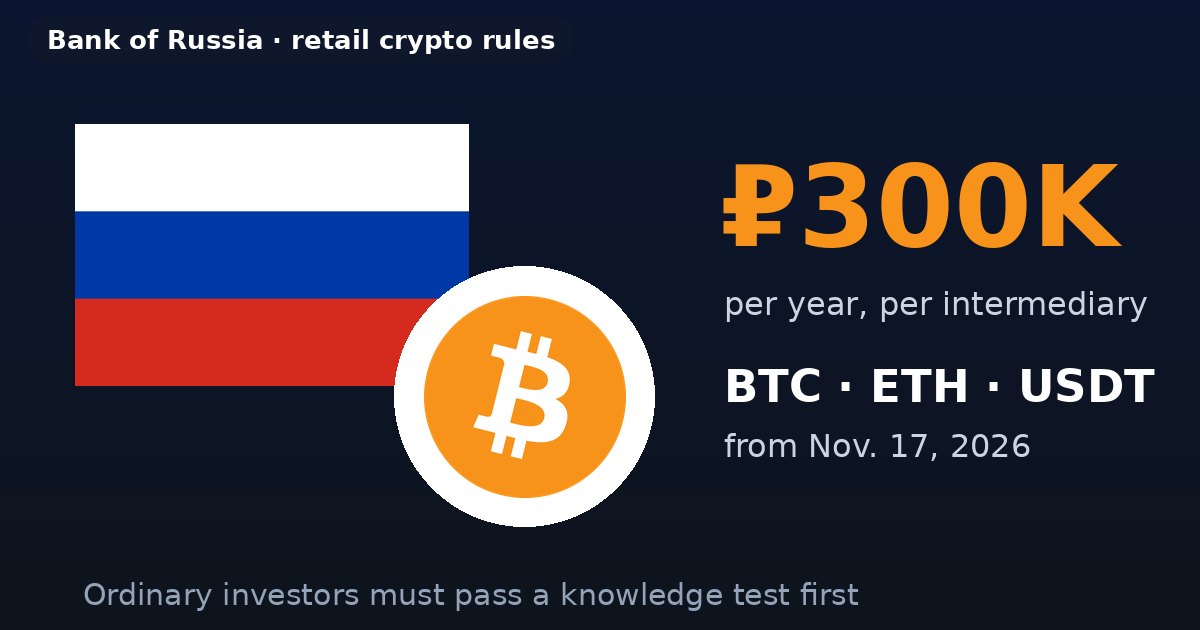
Russia has opened the door for ordinary people to buy cryptocurrency through regulated companies. A Bank of Russia ordinance that took effect on Nov. 17, 2026 lets "non-qualified" investors, the legal term for everyday retail buyers, purchase bitcoin, ether and the dollar-pegged stablecoin USDT, the central bank said.
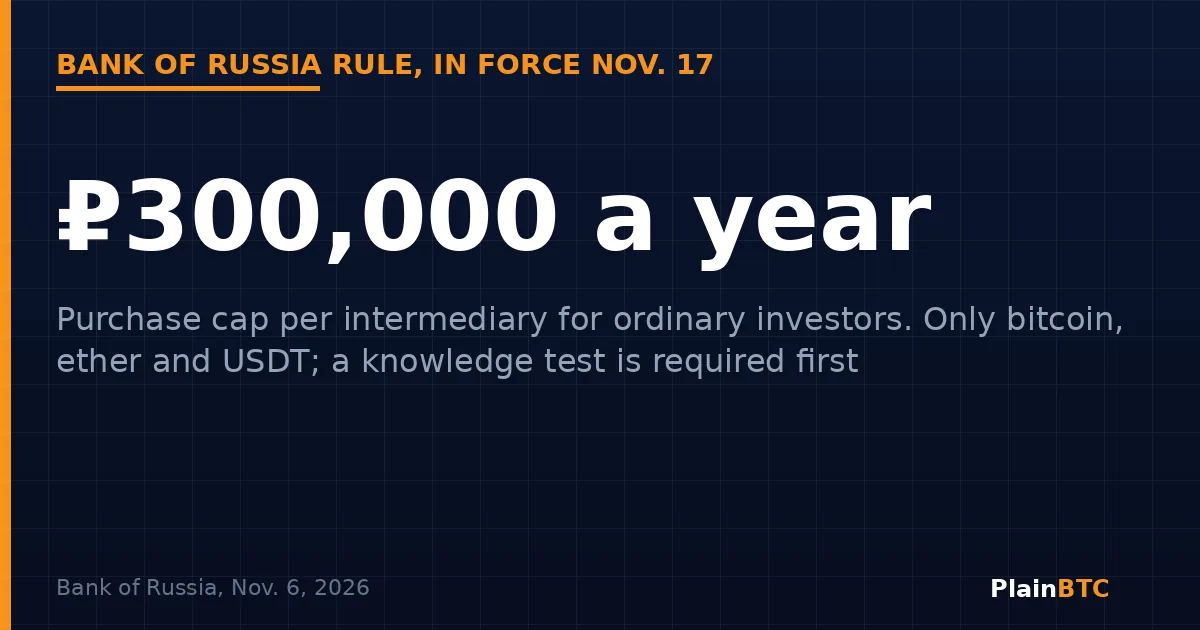
There are limits. Purchases through any single intermediary are capped at 300,000 rubles per year, roughly $3,600 at the central bank's official rate on Tuesday, according to Bitcoin Magazine. Every buyer must also pass a knowledge test and read a risk warning before the first trade.
Key takeaways
- Since Nov. 17, ordinary Russian investors may buy bitcoin, ether and USDT through brokers, trust managers or licensed crypto exchange offices.
- The cap is 300,000 rubles a year per intermediary, not per person. Qualified (wealthier, experienced) investors have no cap and can buy any crypto asset.
- Everyone, regardless of status, must pass a test and read about the risks first.
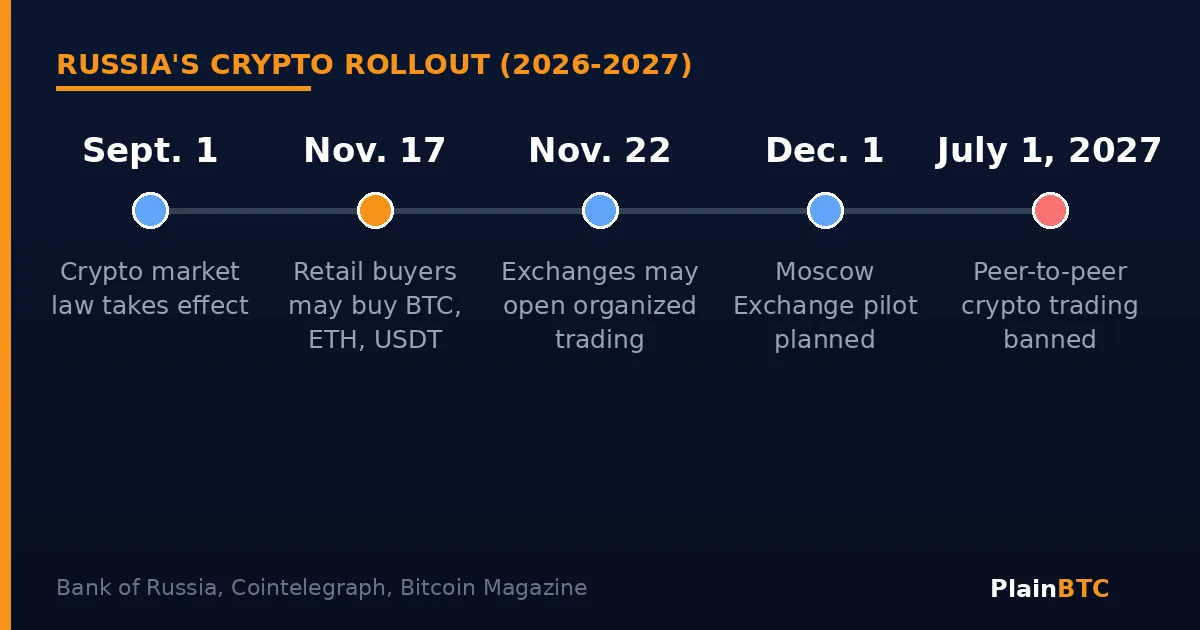
- Big brokers T-Bank and VTB are not offering purchases yet. Exchanges may open organized trading from Nov. 22, and Moscow Exchange plans a pilot on Dec. 1.
What the new rule allows
Under the ordinance, retail buyers can purchase the three approved coins through an intermediary such as a broker, a trust manager or a crypto exchange office, either on an exchange or over the counter (directly between two parties). From the same date, exchanges may admit those three assets to public trading, the Bank of Russia said.
The central bank says it chose only the most liquid assets. It looked at market value, average daily trading volume and at least five years of price history on foreign exchanges. "This approach is intended to mitigate the risks of investing in cryptoassets for non-qualified investors," the regulator said when it announced the list on Nov. 6.
Qualified investors, a status in Russia tied to wealth or professional experience, face no purchase cap and can access any crypto asset. They still have to take the test.
Banks are not ready yet
The legal door opened before the apps did. Two of Russia's largest retail brokers, T-Bank and VTB, were not offering crypto purchases on the first day, Bitcoin Magazine reported, citing comments to the TASS news agency.
"The main reason T-Bank clients do not yet see cryptocurrencies in their banking app is the absence of a market standard for testing," said Alexander Kretov, who leads blockchain development at T-Bank. He said the bank is ready to launch as soon as the Bank of Russia publishes that standard. VTB said it is testing the customer flow in its investment app and plans to open crypto trading first to qualified investors who pass the test, according to BeInCrypto.
What comes next, and what is banned
Nov. 17 is only the first date on Russia's calendar. Under a separate ordinance, exchanges may open organized crypto trading from Nov. 22 once the central bank approves their trading rules. Moscow Exchange, the country's largest exchange, plans to start bitcoin, ether and USDT trading on Dec. 1 as a pilot, according to Cointelegraph. The exchange and its clearing house are under U.S. sanctions.
The new access comes with tighter control outside licensed channels. According to Cointelegraph, direct peer-to-peer crypto trading will be banned from July 1, 2027, transfers from regulated accounts to self-custody wallets are already prohibited, and paying for goods and services with crypto remains illegal in Russia. The legal framework rests on a crypto market law that took effect on Sept. 1.
Some market participants doubt the cap will pull many buyers home. Dmitry Lesnov of the brokerage Finam told the newspaper Vedomosti that Russians already trade heavily on offshore platforms and that the 300,000-ruble limit will significantly limit retail interest, Bitcoin Magazine reported.
Why it matters, and what it means for beginners
Russia is a large crypto market, and this is the first time its rules give ordinary residents a licensed, domestic way to buy bitcoin. The timing is notable: bitcoin traded around $64,100 on Wednesday, about 26% below its October high, according to CoinDesk.
For readers in the U.S., nothing changes directly. Americans can already buy crypto through regulated platforms without an annual cap. Many beginners start with a small amount on a large exchange such as Coinbase and add slowly over time. Russia's approach does carry one lesson worth copying, though: understand the risks before you buy. Crypto prices can swing sharply, so only use money you can afford to lose. This is not investment advice.
What to watch next
- When the Bank of Russia publishes the standard investor test, and whether T-Bank, VTB and Sberbank switch on purchases.
- Whether exchanges open organized trading after Nov. 22, and how Moscow Exchange's Dec. 1 pilot goes.
- Whether the 300,000-ruble cap changes once the market is running.
New to wallets? Read What is a crypto wallet: custodial vs. self-custody.
Bonus Partner offer
Up to$100 in bitcoin
Get up to $100 in bitcoin on River- Create a new River account through this referral link.
- Buy at least $100 of bitcoin with cash from a linked bank account.
- Get $5 in bitcoin, then up to $100 as you buy more within 180 days. U.S. only.
Referral link, we may earn a bonus. Details
Not financial advice. This article is for informational and educational purposes only. It is not investment, trading, legal, or tax advice. Cryptocurrency is volatile and you can lose money. Do your own research and consider speaking with a qualified professional before making financial decisions.
Sources
- Bank of Russia: Cryptocurrencies for non-qualified investors: Bank of Russia ordinance (Nov 6, 2026)
- Bitcoin Magazine: Russia lets everyday investors buy bitcoin starting today (Nov 17, 2026)
- Cointelegraph: Russia finalizes crypto trading rules ahead of Nov. 17 rollout (Nov 6, 2026)
- BeInCrypto (Russian): Bank of Russia crypto ordinance takes effect, what investors need to know (Nov 17, 2026)
- CoinDesk: Bitcoin drops as Nvidia earnings report drives stock index futures higher (Nov 18, 2026)