SEC says fake advisers and fake crypto apps took $37 million from 1,500 Americans
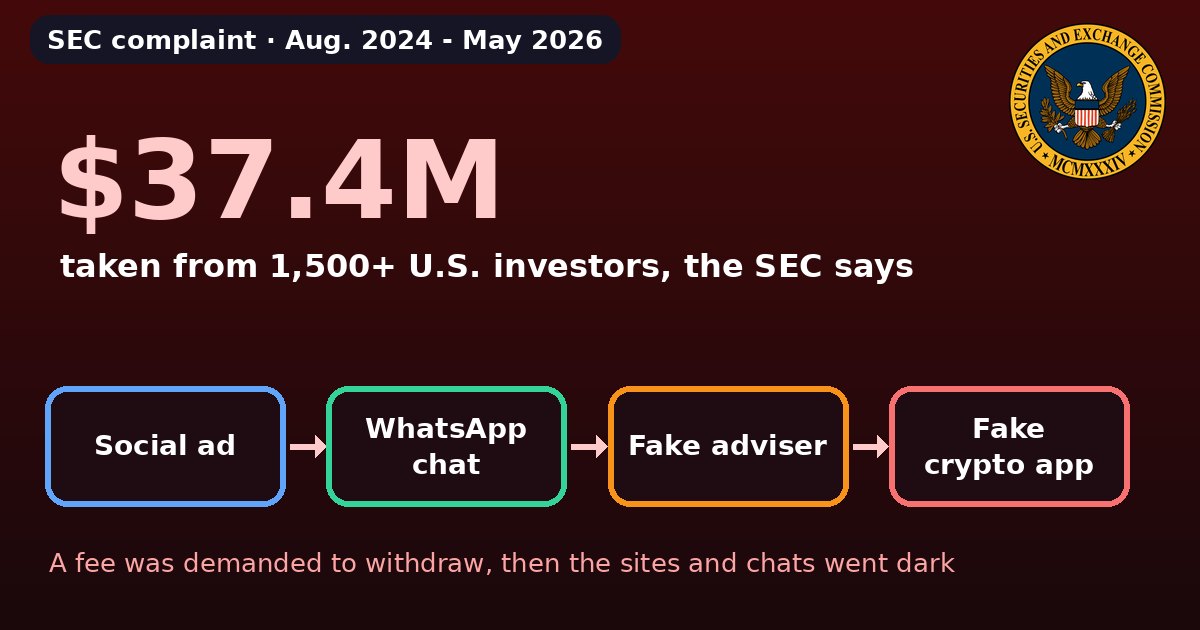
The U.S. Securities and Exchange Commission says a network of fake investment advisers and fake crypto trading platforms took more than $37 million from ordinary Americans. On Thursday, Nov. 19, the SEC charged eight Colorado-based entities, which it says were "likely operated by individuals located overseas," with fraud.
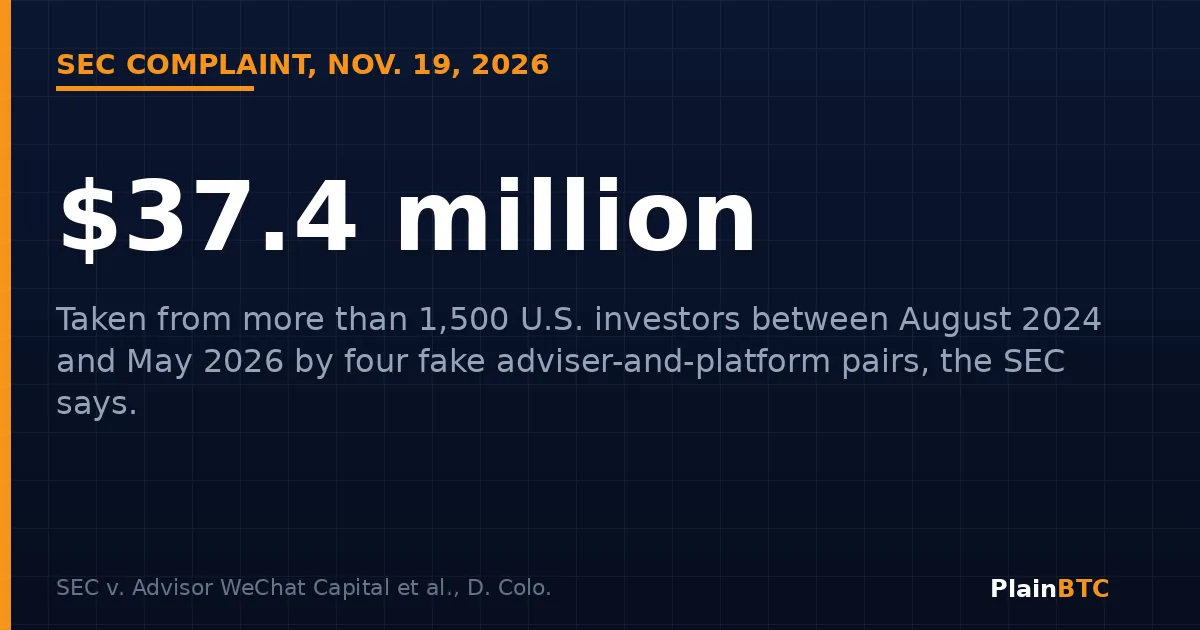
According to the SEC's complaint, filed in federal court in Colorado, the scheme took $37,445,800 from more than 1,500 U.S. investors between August 2024 and May 2026. Some victims sold stocks, cashed out 401(k) retirement savings or borrowed from family to keep investing. None of the companies is a real adviser or exchange, the SEC says.
Key takeaways
- The SEC charged eight Colorado-based entities over a scheme it says took about $37.4 million from more than 1,500 U.S. investors.
- Victims were pulled in through social media ads and WhatsApp chats run by fake investment advisers.
- The fake "platforms" showed made-up gains, then demanded a fee before any withdrawal.
- The SEC says the scammers sent fake SEC "certificates" and pointed to real filings to look legitimate.
How the scheme worked
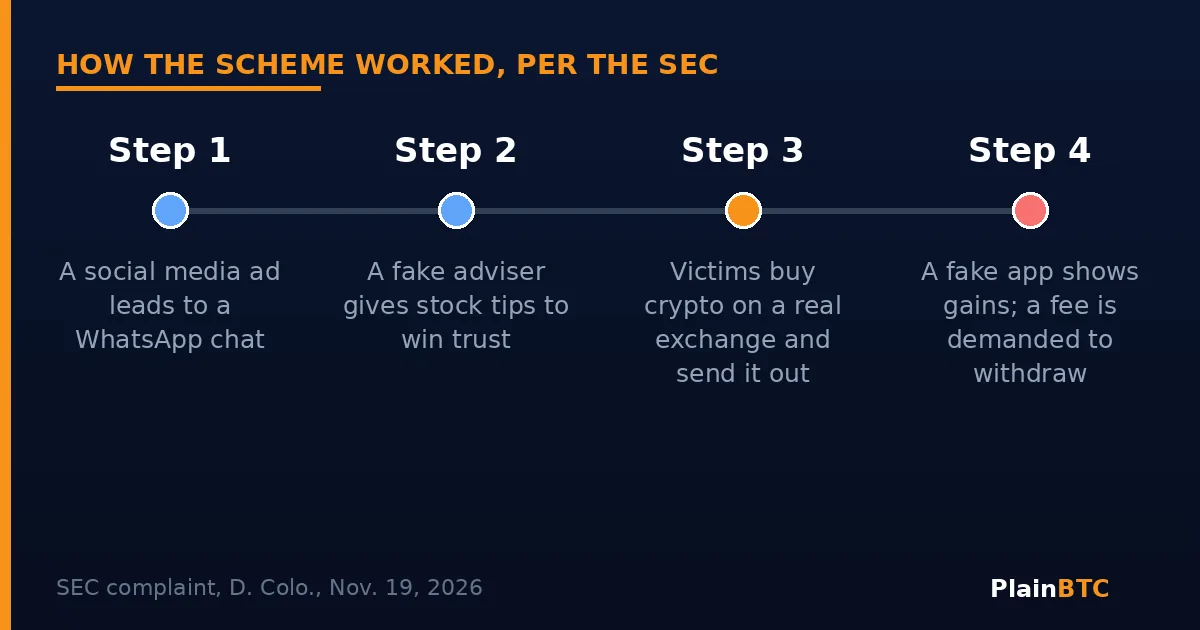
The playbook was the same each time, the complaint says. A social media ad led people to a WhatsApp group run by someone claiming to work for an investment adviser. The "adviser" first gave tips on ordinary U.S. stocks to build trust. Then came the pitch: exclusive crypto offerings, called IEOs, said to be more profitable than anything else.
Victims were told to put dollars into an account at a well-known U.S. crypto exchange, buy crypto such as ether, USDT or USDC, move it to their own wallet and then send it to an address the adviser provided. They were also told to download an app for the paired "trading platform." The app looked real and showed balances and trades. None of it existed, the SEC says, and the money was quickly moved through a network of wallets and bridges.
When victims tried to take out their supposed profits, they were told to first pay a fee, a percentage of those profits, sent in crypto to yet another address. People who refused were pressured and threatened, according to the complaint. In the end, nobody could withdraw anything, the websites went offline and the chats went silent.
Four fronts, one network
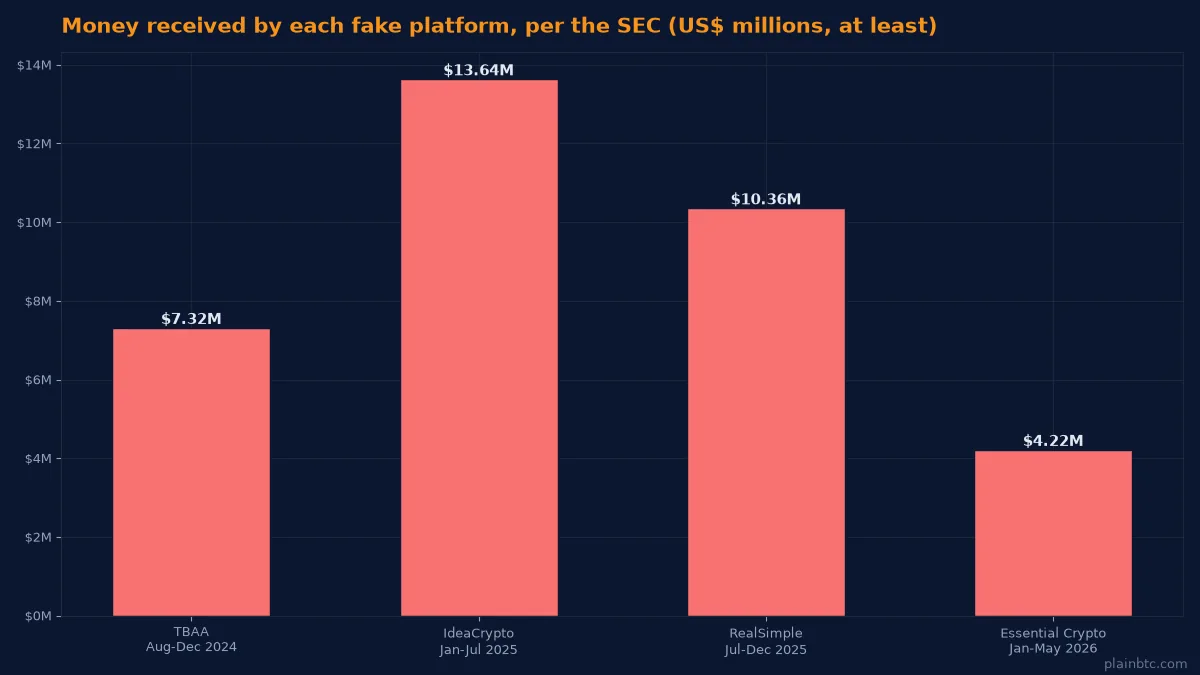
The SEC says the defendants worked in four adviser-and-platform pairs, each running for about six months before disappearing and being replaced by the next. The complaint lists at least $7.3 million received by Tech Brokerage Asset Alliance, $13.6 million by IdeaCrypto Exchange, $10.4 million by RealSimple Crypto Exchange and $4.2 million by Essential Crypto Exchange.
The losses for some people were life-changing. The complaint describes one investor who lost nearly $500,000, including money borrowed from a 401(k), a son and a neighbor, and another who lost close to $1.6 million, including the person's house and retirement account.
To look trustworthy, the scammers sent some victims a fake SEC "certificate" and pointed to filings made with the SEC, FINRA or FinCEN. Filing a form with a regulator does not mean the regulator approves or watches a company, the SEC notes. It also says identical "contests" between two fake advisers, to pick who would manage a supposed $10 billion fund, ran in all four versions of the scheme.
The SEC is asking the court for permanent injunctions, the return of ill-gotten gains with interest, and civil penalties. Regulators in Hong Kong, Singapore, China and Switzerland helped with the case, Bitcoin.com News reported. The charges are allegations, and no court has found the defendants liable.
How to protect yourself
This kind of scam relies on trust built over weeks, not on hacking. A few simple rules block most of it:
- Be wary of investment tips from strangers in WhatsApp, Telegram or social media groups.
- Check any adviser or firm on the SEC's free Investor.gov tool before sending money. A "certificate" sent by the firm proves nothing.
- Never pay a fee or "tax" to withdraw your own money. That is a classic sign of fraud.
- Only buy and keep crypto on platforms you found yourself, such as a large regulated exchange like Coinbase, not one a new contact pointed you to.
If you think you were targeted, report it to the FBI at ic3.gov and to the SEC. This is not financial or legal advice.
What to watch next
- Whether the court freezes any of the funds or orders the defendants to pay.
- Whether criminal charges follow against the people behind the companies.
- More SEC and FBI warnings about group-chat investment scams.
Learn how to keep your account safe in Is Coinbase safe for beginners?
Bonus Partner offer
$50 in crypto
Get $50 in crypto on Gemini- Verify your ID.
- Trade at least $100 within 30 days of signup.
- U.S. users get $50 in crypto, paid about 32 days after signup.
Referral link, we may earn a bonus. Details
Not financial advice. This article is for informational and educational purposes only. It is not investment, trading, legal, or tax advice. Cryptocurrency is volatile and you can lose money. Do your own research and consider speaking with a qualified professional before making financial decisions.
Sources
- SEC: Eight Entities Used Fake Crypto Asset Trading Platforms to Steal More Than $37 Million From U.S. Investors (Nov 19, 2026)
- SEC complaint: SEC v. Advisor WeChat Capital et al., U.S. District Court for the District of Colorado (Nov 19, 2026)
- Bitcoin.com News: SEC charges 8 entities in $37 million fake crypto platform case (Nov 20, 2026)
- Investor.gov: check the background of investment professionals (SEC) (Nov 20, 2026)
- FBI Internet Crime Complaint Center (IC3) (Nov 20, 2026)