Goldman Sachs, Citi and other banks reportedly commit $270 million to a joint dollar stablecoin
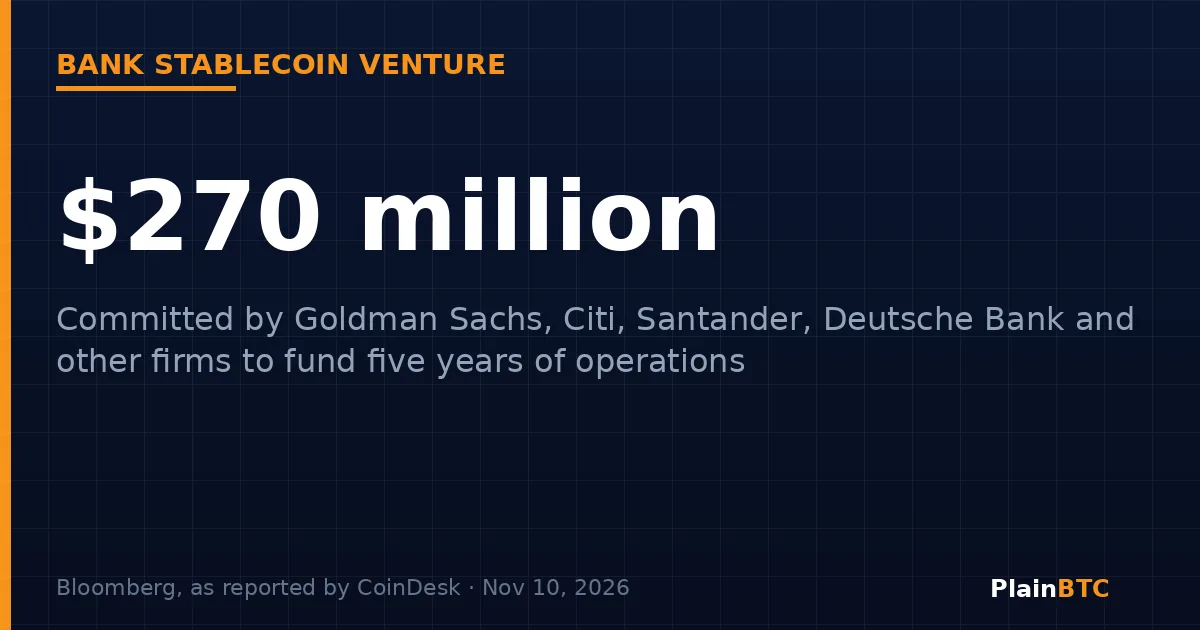
Some of the world's biggest banks are putting real money behind their own digital dollar. Goldman Sachs, Citigroup, Banco Santander, Deutsche Bank and other financial firms have committed about $270 million to a joint stablecoin venture, Bloomberg reported on Tuesday, Nov. 10, citing people familiar with the matter.
According to the report, the money is meant to cover five years of operating costs at a new company that will issue a dollar-denominated stablecoin and is expected to be incorporated in the United States. The project is known internally as Project Faro, does not yet have an official name and is still searching for a chief executive. CoinDesk said the participating banks did not immediately respond to its requests for comment.
Key takeaways
- About $270 million was reportedly committed to fund five years of a bank-owned stablecoin company.
- The group of 21 financial institutions announced the plan on Sept. 1, 2026, and aims to launch in the first half of 2027.
- It will start with a U.S. dollar stablecoin, then add other G7 currencies, with a euro token first.
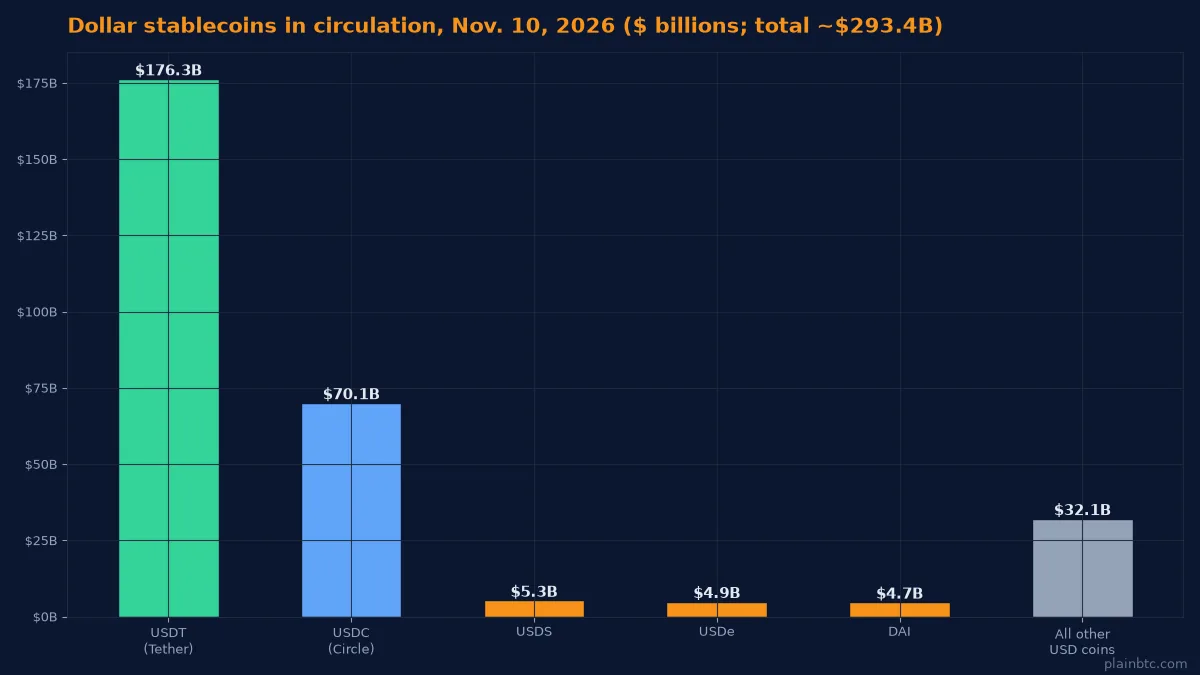
- Tether's USDT and Circle's USDC hold about 84% of the roughly $293 billion in dollar stablecoins, per DefiLlama.
What is a stablecoin?
A stablecoin is a crypto token designed to stay worth a fixed amount, usually one U.S. dollar. The issuer holds reserves, such as cash and short-term Treasury bills, to back every token. People use stablecoins to move dollars between crypto apps, to pay across borders, and to park money between trades without converting back to a bank account.
Who is in the group
The venture was first made public on Sept. 1, 2026. In a joint press release, 21 institutions said they had committed to set up a new company in the second half of 2026, subject to closing conditions, and aim to bring their stablecoin to market in the first half of 2027. The North American members are Bank of America, Capital One, Citi, Fidelity Investments, Goldman Sachs, PNC Financial Services, Scotiabank, TD Bank Group, Wells Fargo and WisdomTree. European members include Santander, BBVA, Deutsche Bank, Lloyds, UBS and others, alongside MUFG Bank, Sirius International Holding and Standard Bank.
The group said the coin will start in U.S. dollars, with a longer-term plan to add stablecoins in other G7 currencies and a euro version as a priority. It expects uses in wholesale, institutional and retail markets, including cross-border payments and settling digital asset trades. The banks said they intend to comply with the U.S. GENIUS Act, the federal stablecoin law passed in 2025, and Europe's MiCA rules where they apply.
Taking on Tether and Circle
The banks are entering a market already dominated by two crypto companies. Data from DefiLlama on Nov. 10 shows about $293.4 billion of dollar-pegged stablecoins in circulation. Tether's USDT accounts for about $176.3 billion, or 60%, and Circle's USDC for about $70.1 billion, or 24%. No other dollar coin tops $6 billion.
Euro stablecoins are tiny by comparison: DefiLlama puts all of them together at well under $1 billion, which helps explain why the group sees room for a bank-backed euro token.
The banks are not the only big players trying to break in. CoinDesk noted that more than 140 companies, including Stripe, Visa, Mastercard and BlackRock, teamed up in June on a separate dollar stablecoin project. Banks hope their existing customers and payment networks will give them an edge.
What it means for beginners
Nothing changes for you today. The coin does not exist yet, it has no name, and the launch target is still months away. If it arrives, it could mean that the bank you already use lets you hold or send digital dollars, possibly with the same kind of compliance checks you get for a regular transfer.
Keep in mind that a stablecoin is not a bank deposit. Even under the GENIUS Act, stablecoins are not FDIC-insured, and their safety depends on the issuer's reserves and rules. If you use stablecoins now, stick to well-known coins on regulated U.S. platforms. This is not investment advice.
What to watch next
- An official name, a chief executive and a closing date for the new company.
- Which blockchains the coin will run on and whether retail customers can buy it directly.
- Whether the share held by USDT and USDC starts to shrink once banks enter.
Banks are already testing stablecoin payments. Read how PNC is piloting USDC payments with Coinbase.
If you open a Gemini account
Gemini is not available in every country. As of 6 April 2026, Gemini closed customer accounts in the United Kingdom, the European Economic Area, and Australia, according to Gemini’s official availability page. If Gemini is offered where you live and you decide to sign up, you can use our referral link. Check Gemini’s current terms and areas of availability. This is not investment advice.
Gemini signup page (referral link)Not financial advice. This article is for informational and educational purposes only. It is not investment, trading, legal, or tax advice. Cryptocurrency is volatile and you can lose money. Do your own research and consider speaking with a qualified professional before making financial decisions.
Sources
- Bloomberg — Goldman, Citi Among Banks in $270 Million Stablecoin Backing (Nov 10, 2026)
- CoinDesk — Goldman Sachs, Citi among banks said to commit $270 million to stablecoin venture (Nov 10, 2026)
- Banco Santander — Group of leading international financial institutions to establish stablecoin enterprise (Sep 1, 2026)
- DefiLlama — Stablecoins circulating supply (Nov 10, 2026)