Judge acquits MIT brothers in $25 million Ethereum trading-bot case, ending the first U.S. criminal MEV prosecution
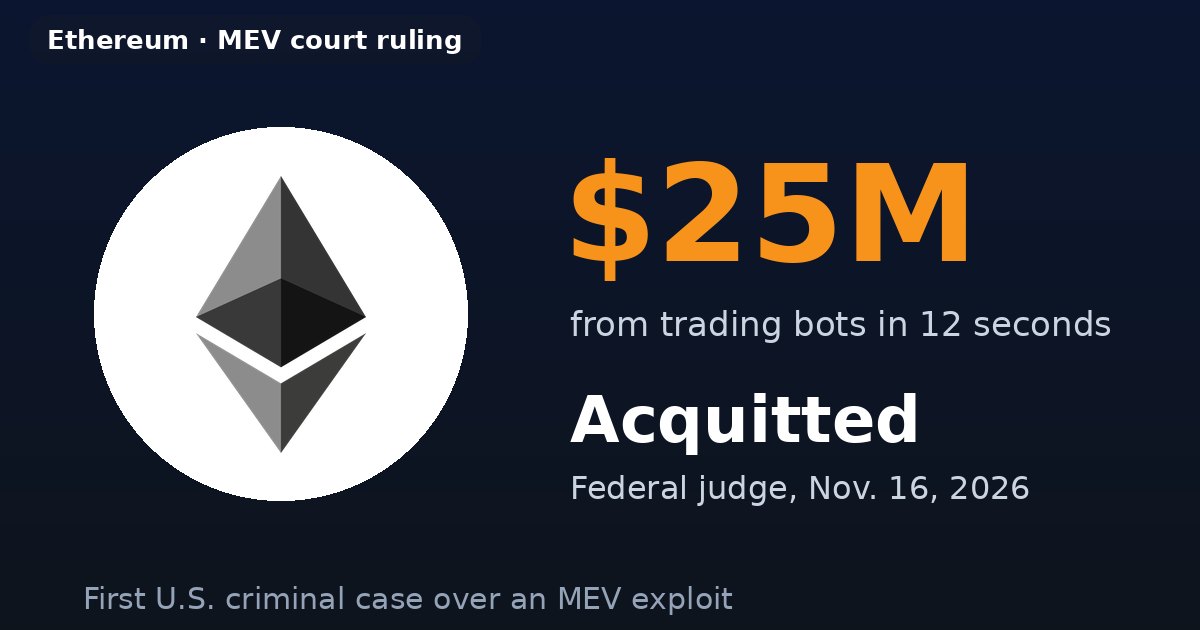
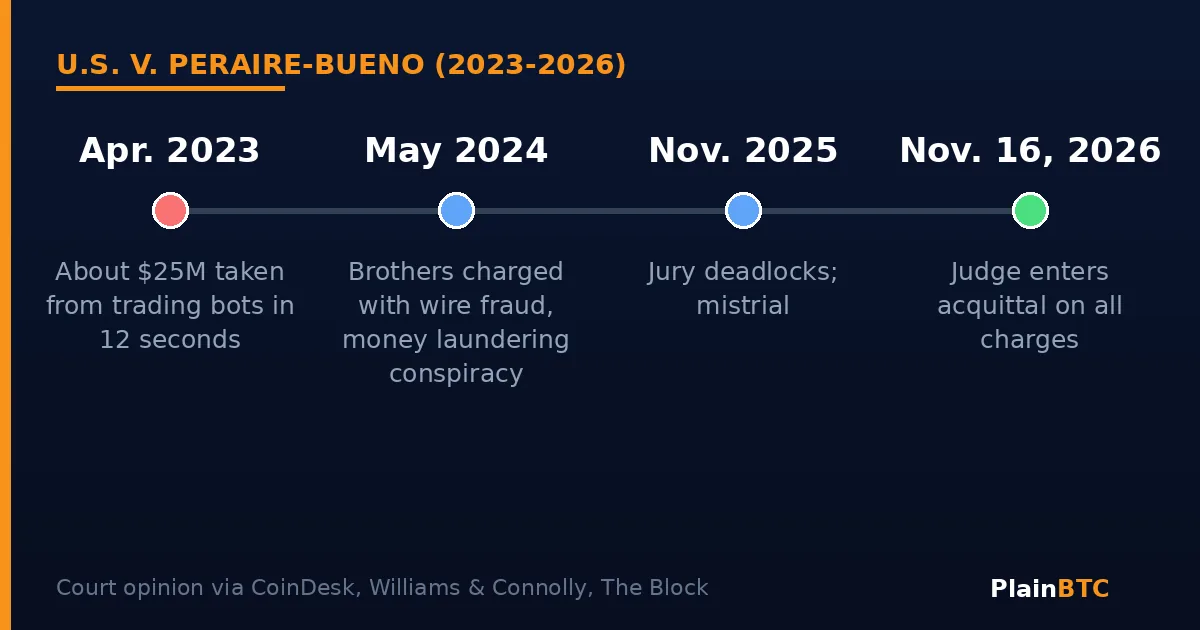
A federal judge in Manhattan has acquitted two brothers accused of taking about $25 million from automated Ethereum trading bots in 12 seconds. U.S. District Judge Jessica Clarke entered a judgment of acquittal for Anton and James Peraire-Bueno on Nov. 16, 2026, on charges of wire fraud, conspiracy to commit wire fraud and conspiracy to commit money laundering, CoinDesk reported from her opinion.
The ruling closes what the government called a "first of its kind" prosecution over MEV, a way of profiting from the order of transactions on a blockchain. It came a year after a jury deadlocked and the judge declared a mistrial in November 2025.
Key takeaways
- Judge Jessica Clarke acquitted the Peraire-Bueno brothers on all charges on Nov. 16 and directed the court to close the case.
- Prosecutors said the brothers baited trading bots in April 2023 and exploited a software flaw to take about $25 million in 12 seconds.
- The judge ruled the government failed to prove a "material misrepresentation," a lie that matters, which wire fraud requires.
- The ruling does not say the trade was right. It says it was not wire fraud under the law prosecutors used.
What MEV is, in plain English
When you send a transaction on Ethereum, it first waits in a public queue called the mempool until a validator, the network participant chosen to add the next block, includes it. MEV, short for maximal extractable value, is the extra profit available to whoever controls the order of transactions in a block.
Many trading bots hunt for that profit with a "sandwich." A bot spots a large pending purchase, buys the same token just before it, lets the purchase push the price up and then sells right after. The person in the middle gets a worse price.
How the trade worked
According to the court's opinion, as described by CoinDesk, the brothers set a trap in April 2023. They placed eight bait transactions designed to attract sandwich bots. When their own validator's turn came, a relay called Ultrasound offered it a block full of the bots' trades. The validator signed the block's header, a kind of summary, with two key fields set to zero. The relay did not check those fields and revealed the block's contents anyway.
With the bots' trades visible, the brothers built their own block. It kept the bots' purchases but replaced the bait with sales that crashed the price before the bots could sell. The bots lost about $25 million. The brothers' validator was penalized about 1 ether. The scheme was known as "Omakase." According to the brothers' law firm, Williams & Connolly, prosecutors alleged it exploited a flaw in MEV-Boost, open-source software used by most Ethereum validators.
Why the judge said it was not fraud
Wire fraud requires a material misrepresentation, a lie that someone relied on. Judge Clarke found none. The bait trades made no promise, she wrote, because "no trader who places a transaction in the public mempool would agree to be sandwiched." The false signature did not count either, because the relay never checked the zeroed fields, so it "had no effect on the behavior of its recipient."
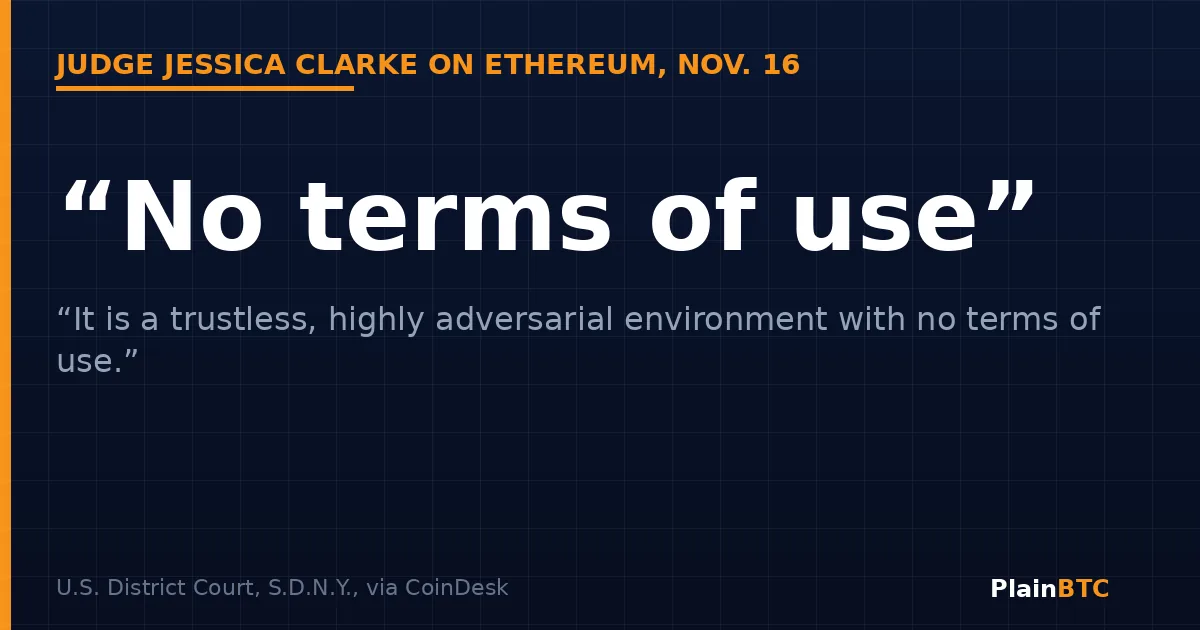
She described Ethereum as "a trustless, highly adversarial environment with no terms of use." And she was clear about the limits of her ruling: "The question before the Court is not whether the Peraire-Buenos' conduct was right or moral, or even whether it violated uncharged crimes," she wrote, as quoted by BleepingComputer. Once the fraud counts fell, the money laundering conspiracy charge fell too.
The case so far
The brothers, who studied at MIT, were charged in May 2024. After a nearly four-week trial in late 2025, the jury could not agree on a verdict, according to Williams & Connolly. Only one wallet, holding about $3 million of the proceeds, was ever frozen, and the brothers had moved the rest out by October 2023, CoinDesk reported. The Block noted that the judge also pointed out the trades did not happen on a regulated market where such conduct would be prohibited. It is not yet clear whether the government will try to challenge the ruling.
What it means for beginners
For ordinary crypto users, the main lesson is practical. Decentralized trading on blockchains like Ethereum is, in the judge's words, adversarial, and sandwich bots still exist. If you swap tokens on a decentralized exchange, keep your slippage setting low and be careful with large trades in thin markets. If you simply want to own some crypto without dealing with bots and mempools, many beginners buy on a large regulated exchange such as Coinbase instead. Any crypto purchase can lose value, so only use money you can afford to lose. This is not investment advice.
What to watch next
- Whether prosecutors try to challenge the acquittal.
- Whether other MEV-related cases are brought under different laws.
- How the ruling is cited in future crypto fraud cases.
Want to keep your coins safe? Read What is a crypto wallet: custodial vs. self-custody.
Bonus Partner offer
Up to$100 in bitcoin
Get up to $100 in bitcoin on River- Create a new River account through this referral link.
- Buy at least $100 of bitcoin with cash from a linked bank account.
- Get $5 in bitcoin, then up to $100 as you buy more within 180 days. U.S. only.
Referral link, we may earn a bonus. Details
Not financial advice. This article is for informational and educational purposes only. It is not investment, trading, legal, or tax advice. Cryptocurrency is volatile and you can lose money. Do your own research and consider speaking with a qualified professional before making financial decisions.
Sources
- CoinDesk: U.S. judge says Ethereum has 'no terms of use,' clears MIT brothers of $25 million fraud (Nov 18, 2026)
- Williams & Connolly: Williams & Connolly secures victory on behalf of client James Peraire-Bueno (Nov 2026)
- The Block: Peraire-Bueno brothers acquitted of wire fraud in $25 million Ethereum MEV case (Nov 16, 2026)
- BleepingComputer: Court clears brothers of $25 million Ethereum crypto heist charges (Nov 2026)