Lighter pauses withdrawals after a leaked trading key lets an attacker take $10.4 million
Lighter, a decentralized exchange for crypto futures trading, paused all withdrawals on Monday morning after an attacker used a single trader's leaked API key to move about $10.4 million in the USDC stablecoin off the platform, CoinDesk reported. Lighter said its own software and smart contracts were not hacked.
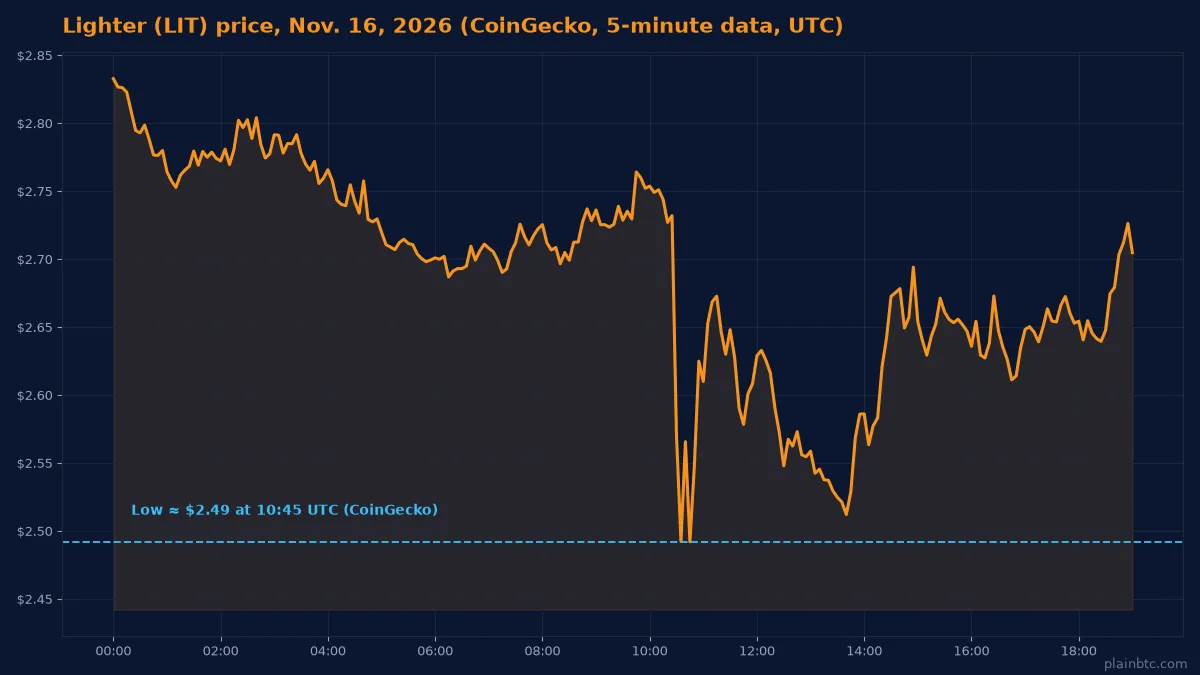
By midday, the exchange said it had recovered about $5 million for the affected trader and reopened deposits and withdrawals. Its LIT token fell more than 10% to under $2.48 after the news, then recovered to about $2.62, CoinDesk reported.
Key takeaways
- An attacker used one trader's leaked API key to withdraw about 10.39 million USDC from Lighter on Monday, Nov. 16.
- Lighter paused withdrawals and new pool creation for about seven hours and says its protocol and smart contracts were unaffected.
- The key leaked because the trader's own signing code reused a one-time number, a known cryptography mistake.
- About $5 million was returned to the trader, and withdrawals reopened at about 12:21 p.m. Central time.
What happened
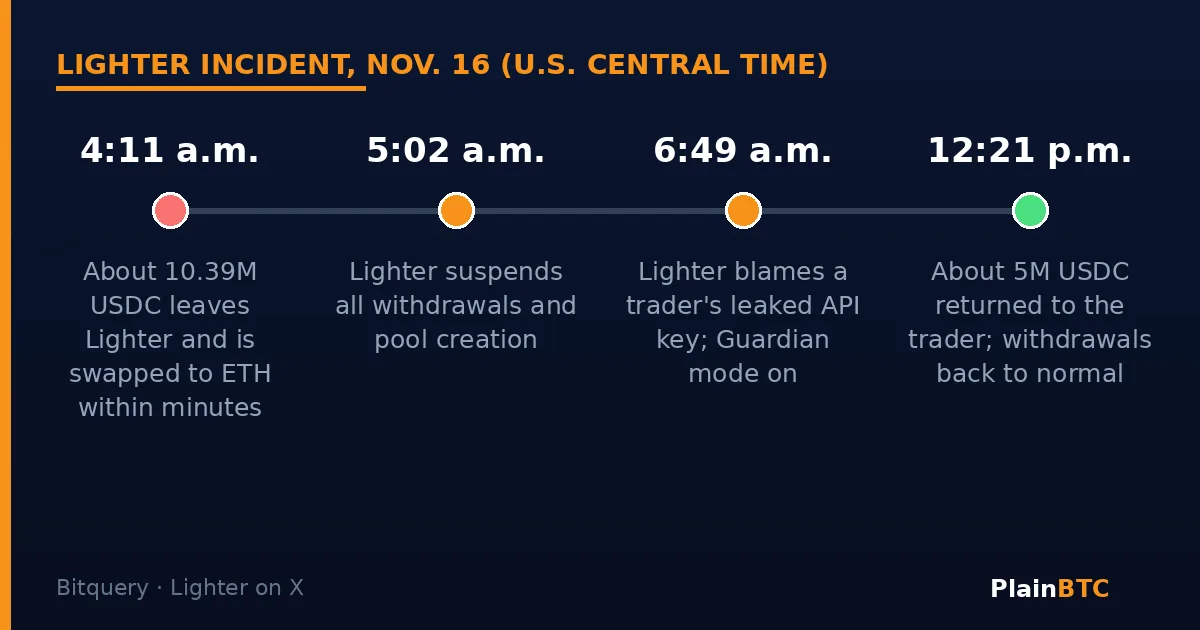
An API key is a password-like code that lets trading bots place orders on an account without the owner clicking anything. According to blockchain data firm Bitquery, about 10,393,057 USDC left Lighter's Ethereum contract at about 4:11 a.m. Central time on Monday. The receiving wallet swapped the money into ether within about four minutes.
Less than an hour later, Lighter posted on X that it was investigating "a security incident that appears to involve a single compromised external party" and suspended all withdrawals and pool creation. In an update at about 6:49 a.m. Central time, it said the cause was "a leaked API key for a specific trader's account" and named the wallet it believes belongs to the attacker.
Analytics firm Bubblemaps tracked the same wallet, Cointelegraph reported. Bitquery found that 1,920 ETH, worth about $3.5 million, was then sent through 12 new wallets of 160 ETH each to the Hyperliquid exchange, where each bought a token called XMR1, named after the privacy coin Monero. Another 3,845 ETH was still in the main wallet at Bitquery's last check.
Some researchers put potential losses at about $15.5 million across two market-maker accounts. Lighter has not confirmed that higher figure.
How the key leaked
In a detailed write-up posted around midday Monday, Lighter said the affected accounts did not use its official software kits. Their own signing code reused a "nonce," a random one-time number that must be different for every digital signature. Because signatures are public, two signatures made with the same nonce let anyone calculate the secret key. Lighter noted the same weakness applies to Bitcoin and Ethereum signatures.
With the key, the attacker created a public pool from the victim's account, bought pool shares from a separate account, moved the victim's funds into the pool and then cashed out the shares. Lighter's emergency "Guardian" mode was triggered by the unusual activity, which paused withdrawals and let its Security Council return about 5 million USDC to the trader.
What changes now
Lighter said it now requires a wallet signature to move funds into a public pool and has made API key signatures non-public. It plans to add IP allowlists, so a key only works from a chosen server, plus limits and permissions for each key. It told anyone unsure about their code to rotate all API keys and switch to an official kit.
At about 12:21 p.m. Central time, Lighter said deposits and withdrawals were "back to normal" and pending withdrawals were being processed. It has not said whether the rest of the trader's loss will be covered.
What it means for beginners
Most beginners never create API keys, but this case shows that a crypto account is only as safe as its keys. If you connect a trading bot or tax app to an exchange, give the key the fewest permissions possible, never paste it into code you share, and delete keys you no longer use. Many newcomers prefer to start on a large regulated exchange such as Coinbase, where you buy and sell through the app instead of running your own code. This is not investment advice.
What to watch next
- Whether Lighter recovers more of the funds or repays the rest of the trader's loss.
- When the promised IP allowlists and per-key limits go live.
- Whether the higher $15.5 million loss estimate is confirmed.
Not sure where to keep your coins? Read what a crypto wallet is: custodial vs. self-custody.
Bonus Partner offer
Up to$100 in bitcoin
Get up to $100 in bitcoin on River- Create a new River account through this referral link.
- Buy at least $100 of bitcoin with cash from a linked bank account.
- Get $5 in bitcoin, then up to $100 as you buy more within 180 days. U.S. only.
Referral link, we may earn a bonus. Details
Not financial advice. This article is for informational and educational purposes only. It is not investment, trading, legal, or tax advice. Cryptocurrency is volatile and you can lose money. Do your own research and consider speaking with a qualified professional before making financial decisions.
Sources
- CoinDesk: Lighter pauses withdrawals after a leaked API key leads to $10.4 million theft (Nov 16, 2026)
- Cointelegraph: Lighter DEX pauses withdrawals following reported $10M exploit (Nov 16, 2026)
- Bitquery: Lighter incident, $10.4M withdrawn, leaving 160 ETH at a time (Nov 16, 2026)
- Lighter on X: Signing Safely on Lighter, lessons from November 16 (Nov 16, 2026)
- Lighter on X: deposits and withdrawals back to normal (Nov 16, 2026)
- CoinGecko: Lighter (LIT) hourly price data (Nov 16, 2026)