Indian exchange Unocoin says hackers used its old paper backup keys to take about $200,000 in crypto
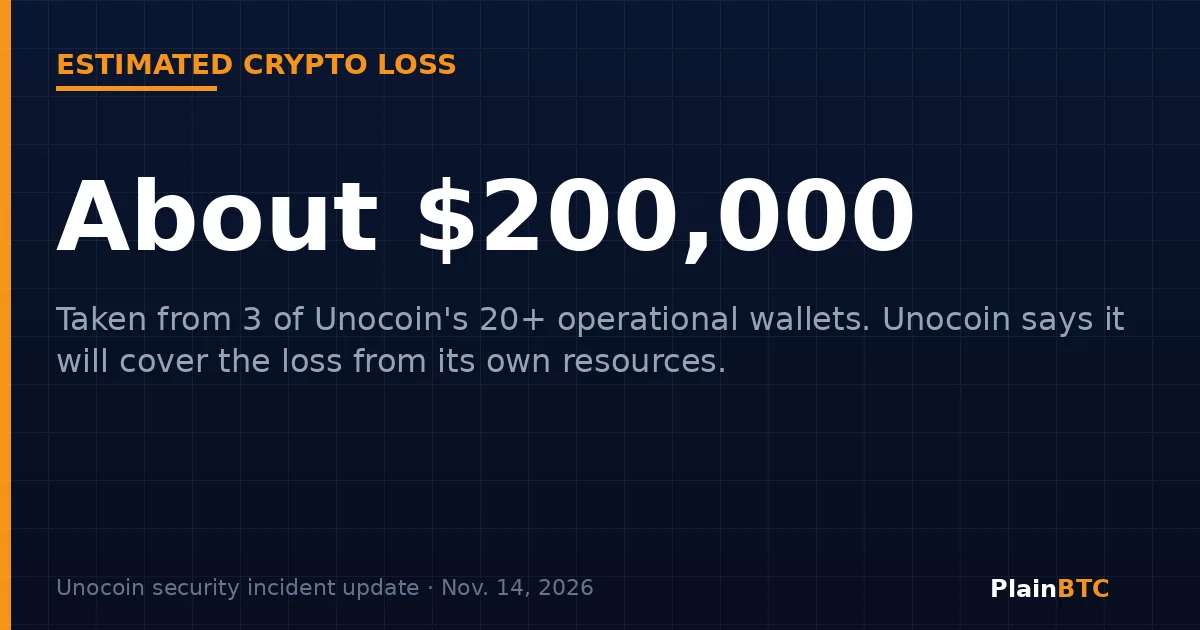
Indian crypto exchange Unocoin said on Saturday, Nov. 14, that attackers took about $200,000 in cryptocurrency from three of its hot wallets, the internet-connected wallets it uses for daily withdrawals. In an incident update, the company said the thieves used backup keys that it had generated about eight years ago, printed on paper and placed in physical storage.
Unocoin, which has served Indian customers since 2013, suspended all of its services on Nov. 9 and has not reopened yet. It said it will cover the loss from its own money and that customers' crypto balances will not be reduced.
Key takeaways
- Unocoin estimates its crypto loss at about $200,000 from three of more than 20 operational wallets, less than 1% of the crypto it holds for customers.
- The transfers were signed with two keys Unocoin controlled, its user key and its backup key, so a freeze at wallet provider BitGo could not block them.
- BitGo says its own key was never used, and Unocoin says BitGo's systems were not compromised.
- Unocoin says customer emails, home addresses, encrypted passwords, KYC-related details and balances may have been exposed.
What happened, step by step
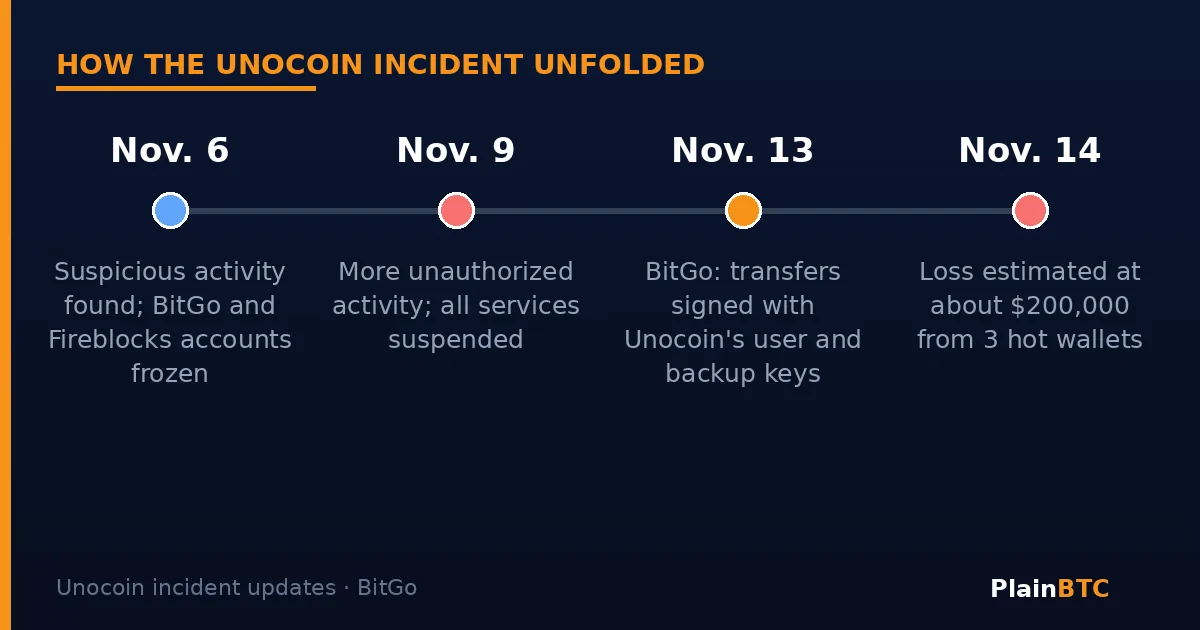
Unocoin said it first spotted suspicious activity on Friday, Nov. 6. That day it asked its wallet providers, Fireblocks and BitGo, to freeze its business accounts, and both confirmed the freezes. After it found more unauthorized activity on Nov. 9, it shut down all services as a precaution. At that point, the company said, it had not found any loss of funds.
That changed on Nov. 12, when Unocoin found outgoing transactions from an Ethereum address in its BitGo wallet setup. BitGo then reviewed the activity and on Nov. 13 published its own account. It found transfers of ERC-20 tokens on Ethereum, XRP on the XRP Ledger, HBAR on Hedera and EOS.
Why the freeze did not stop it
The affected wallets used a 2-of-3 multisignature setup. That means three separate keys exist, and any two of them can approve a transfer. In this case Unocoin held two keys, a "user" key and a "backup" key, and BitGo held the third.
Normal withdrawals go through BitGo's platform, which checks them and adds BitGo's signature. The backup key exists so a customer can still reach its funds if BitGo ever becomes unavailable. BitGo said the transfers it reviewed were signed with Unocoin's user and backup keys and sent straight to the blockchain, outside its platform. Its own key was never used.
A freeze only stops BitGo from signing. "The freeze does not lock funds at the blockchain level," BitGo wrote. Anyone holding both of the other keys can still meet the two-signature rule. BitGo said it has advised Unocoin to move its remaining funds to new wallets with newly generated keys.
Unocoin said it is still trying to work out how the paper backup keys were compromised. It said the passphrase needed to decrypt the printed keys was on its compromised systems, but that this alone "is not fully solving the puzzle." It added that it has already managed to freeze part of the stolen funds through its industry contacts. Questions remain about how the keys were reached and when services will resume, CryptoSlate noted, and BitGo said in a statement cited by crypto.news that no other clients were affected.
Customer data may be exposed
Unocoin said it is treating a large part of its systems as possibly compromised. Information that may have been exposed includes registered email addresses, home addresses, encrypted account passwords, KYC-related details and account balances. The company said it has found no evidence so far that customers' KYC documents were accessed. It warned users to watch for targeted phishing messages and said it will never ask for passwords, one-time codes, private keys or recovery phrases.
What it means for beginners
The same rule applies to your own wallet: whoever holds enough keys controls the coins. If you keep your own crypto, store your recovery phrase offline and away from the devices you use every day, and never type it into a website or share it. If you keep crypto on an exchange, use a strong unique password and app-based or hardware two-step verification. A regulated U.S. exchange such as Coinbase offers these security settings; review its current terms and protections before you sign up. No platform is risk-free. This is not investment advice.
What to watch next
- Unocoin's forensic findings on how the backup keys were compromised.
- When Unocoin restores deposits, withdrawals and trading.
- Whether more of the stolen funds are frozen or recovered.
- Phishing attempts that use leaked customer details.
Not sure who holds the keys to your coins? Read our guide to custodial vs. self-custody crypto wallets.
Bonus Partner offer
Up to$100 in bitcoin
Get up to $100 in bitcoin on River- Create a new River account through this referral link.
- Buy at least $100 of bitcoin with cash from a linked bank account.
- Get $5 in bitcoin, then up to $100 as you buy more within 180 days. U.S. only.
Referral link, we may earn a bonus. Details
Not financial advice. This article is for informational and educational purposes only. It is not investment, trading, legal, or tax advice. Cryptocurrency is volatile and you can lose money. Do your own research and consider speaking with a qualified professional before making financial decisions.
Sources
- Unocoin: Security Incident Update (Nov. 12, 13 and 14, 2026) (Nov 14, 2026)
- BitGo: Unocoin Security Incident: What Happened and Why Wallet Controls Matter (Nov 13, 2026)
- CryptoSlate: Unocoin halts all services after hackers bypass BitGo freeze (Nov 14, 2026)
- crypto.news: BitGo denies breach as Unocoin transfers used client-held keys (Nov 13, 2026)