Binance blocks MEXC transfers after a U.S. Treasury order over $16.7 billion in alleged illicit flows
Binance, one of the world's biggest crypto exchanges, said on Tuesday, Nov. 10, that it will stop processing transactions involving rival exchange MEXC. In a notice to customers, Binance said any request to send funds from a Binance account to MEXC or its listed affiliates will be declined, and any deposit arriving from them will be temporarily withheld for a compliance review.
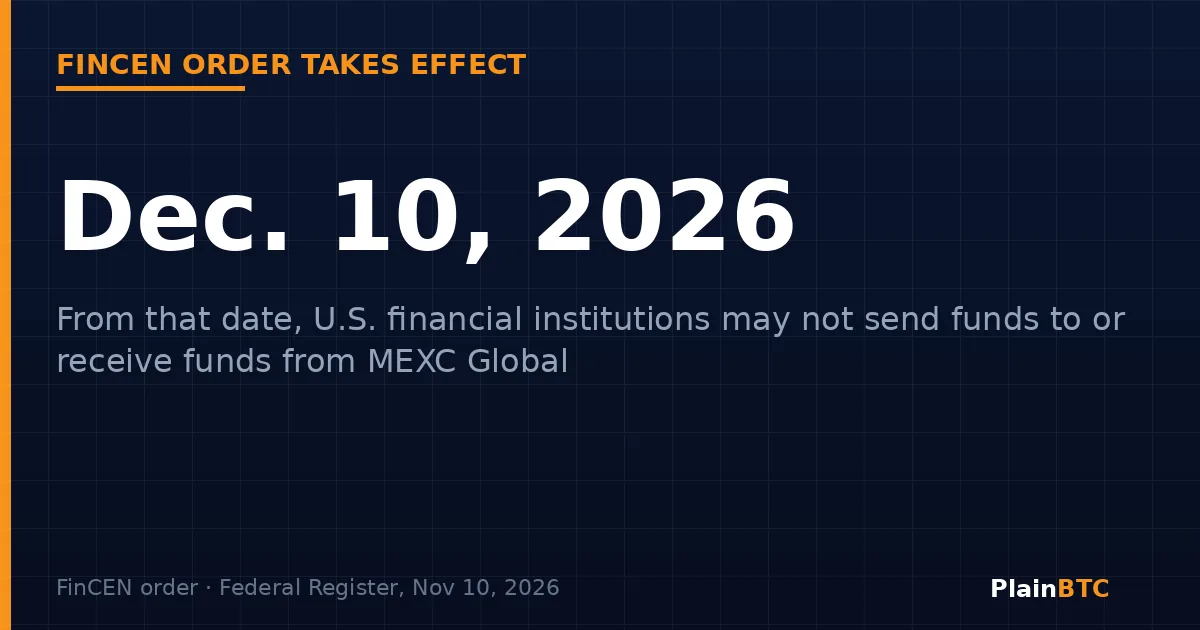
The move follows an order from the U.S. Treasury's Financial Crimes Enforcement Network (FinCEN), announced on Friday, Nov. 6. According to the Treasury, the order effectively cuts MEXC Global off from the U.S. financial system. It was published in the Federal Register on Nov. 10 and takes effect on Dec. 10, 2026, with no end date.
Key takeaways
- Binance will decline withdrawals to MEXC and hold incoming MEXC deposits for a compliance review.
- FinCEN found that MEXC facilitated $16.7 billion in likely illicit activity between May 2021 and May 2026.
- From Dec. 10, 2026, U.S. financial institutions may not send funds to or receive funds from MEXC Global.
- MEXC said it is reviewing the order, is operating normally and has launched an independent review of its controls.
What Binance is doing
Binance said customers should not "directly or indirectly" send funds to, receive funds from, or otherwise transact through Binance with MEXC and a list of related names, including MEXC Global Limited, MEXC Estonia OÜ, GIDA Technology AG and MEXC affiliates. Users whose deposits are flagged may face further restrictions under Binance's terms of use, including being offboarded. Binance did not say how long reviews will take.
Binance is not alone. crypto.news reported that OKX chief executive Star Xu also warned customers against sending crypto directly from MEXC after the FinCEN announcement.
What FinCEN says MEXC did
MEXC Global was founded in 2018 and is incorporated in the Seychelles. FinCEN said it processed more than $1 billion in transactions a day and held about $5 billion in reserves, making it one of the 20 largest crypto exchanges in the world.
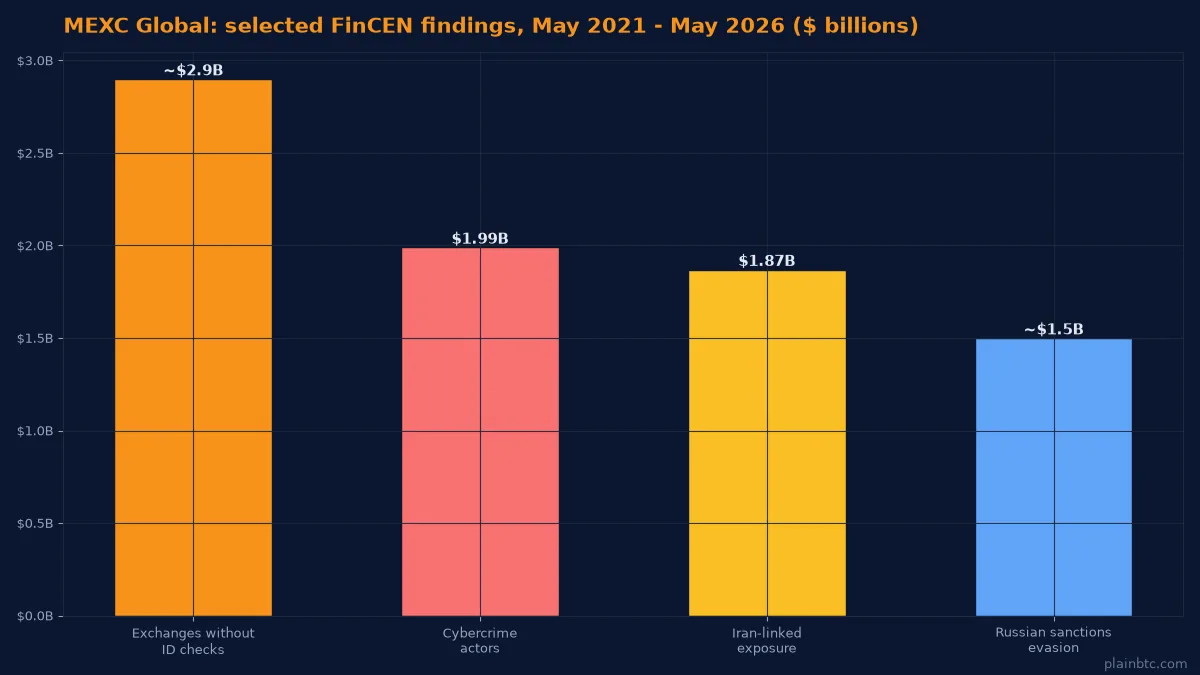
According to the order, MEXC facilitated at least $16.7 billion in likely illicit activity between May 2021 and May 2026. The Treasury's press release rounds this to "at least $16 billion." Among the findings:
- Nearly $1.5 billion linked to Russian sanctions evasion, including $232 million in direct transactions with sanctioned entities.
- Dealings with the sanctioned Russian exchange Garantex and its successor Grinex as recently as June 2026.
- About $1.87 billion with exposure to Iran, including more than $1 billion in direct transactions with over 40 Iranian crypto exchanges.
- About $22 million tied to the Central Bank of Iran and Iran's Revolutionary Guard Corps.
- At least $1.99 billion moving to or from cybercrime actors, such as ransomware and scam operations.
"Financial institutions cannot have it both ways," Treasury Secretary Scott Bessent said in the press release. "Either you support the Iranian regime, or you have access to the U.S. financial system."
Why a Russia law is being used
The order was issued under Section 9714 of the Combating Russian Money Laundering Act. That law can only be used against foreign institutions tied to Russian illicit finance, so the order rests on MEXC's alleged Russian dealings, even though the Treasury presented it as part of a campaign against Iran called Operation Economic Outcast. CoinDesk reported that MEXC is the largest crypto exchange hit under this law; earlier targets included Bitzlato in 2023 and PM2BTC in 2024.
This is not an OFAC sanctions listing. Instead, it bans "covered financial institutions," a group that includes U.S. crypto exchanges and other money transmitters, from sending funds to or receiving funds from MEXC Global. Any MEXC offices located in the United States are excluded from the order.
What MEXC says
MEXC said on Nov. 7 that it is reviewing the order with its legal and compliance teams, that trading continues normally and that customer assets are secure, according to CoinDesk. It also said it has started an independent review of its anti-money-laundering and sanctions controls. MEXC announced in October that it would stop serving users in Russia and Belarus.
What it means for beginners
If you have never used MEXC, this news mostly shows how seriously U.S. regulators now treat compliance at offshore exchanges. If you do hold funds there, be aware that U.S. platforms will be barred from accepting transfers from MEXC once the order takes effect, and big offshore exchanges like Binance are already holding them for review. Moving coins through a personal wallet first may not help, because Binance's notice also covers indirect transactions.
For most U.S. beginners, a simpler path is a regulated U.S. exchange and, for long-term savings, a wallet you control. Avoid platforms that are not licensed where you live. This is not legal or investment advice.
What to watch next
- Whether other large exchanges follow Binance and OKX with their own MEXC restrictions.
- Any formal response from MEXC to FinCEN before Dec. 10.
- How long Binance's compliance reviews of withheld deposits take.
Not sure where your coins should live? Read our guide to custodial vs. self-custody crypto wallets.
Start on Coinbase with this referral link
Open a new Coinbase account through the link below if you are ready to begin. Offer for new U.S. customers; not available in Washington state; terms on Coinbase’s site.
Sign up on Coinbase with this linkNot financial advice. This article is for informational and educational purposes only. It is not investment, trading, legal, or tax advice. Cryptocurrency is volatile and you can lose money. Do your own research and consider speaking with a qualified professional before making financial decisions.
Sources
- Binance — Important: Transactions with Certain Crypto Platforms (Nov 10, 2026)
- U.S. Treasury — Operation Economic Outcast Severs MEXC Global’s Access to the U.S. Financial System (Nov 6, 2026)
- Federal Register — FinCEN order: Imposition of Special Measure Prohibiting the Transmittal of Funds Involving MEXC Global (Nov 10, 2026)
- CoinDesk — U.S. Treasury moves to cut off crypto exchange MEXC over $16 billion in alleged illicit flows (Nov 7, 2026)
- crypto.news — Binance blocks MEXC transfers after FinCEN’s $16B crackdown (Nov 10, 2026)