Korean exchange Coinone says a hacker took support data that may include passwords
South Korean crypto exchange Coinone has told customers that some of their personal data was leaked after an attacker broke into the servers of MetaM, the outside company that runs its customer support. The exchange disclosed the incident in an official notice posted on Sunday morning, Korea time, and apologized to users.
The leaked records come from support chats and phone calls. Depending on what each customer said during those conversations, they may include passwords, national ID numbers, bank account numbers, home addresses and crypto wallet addresses. Coinone says its own account, trading and wallet systems were not broken into.
Key takeaways
- An attacker accessed servers of MetaM, Coinone's outsourced support firm, at about 4 a.m. Korea time on Nov. 12.
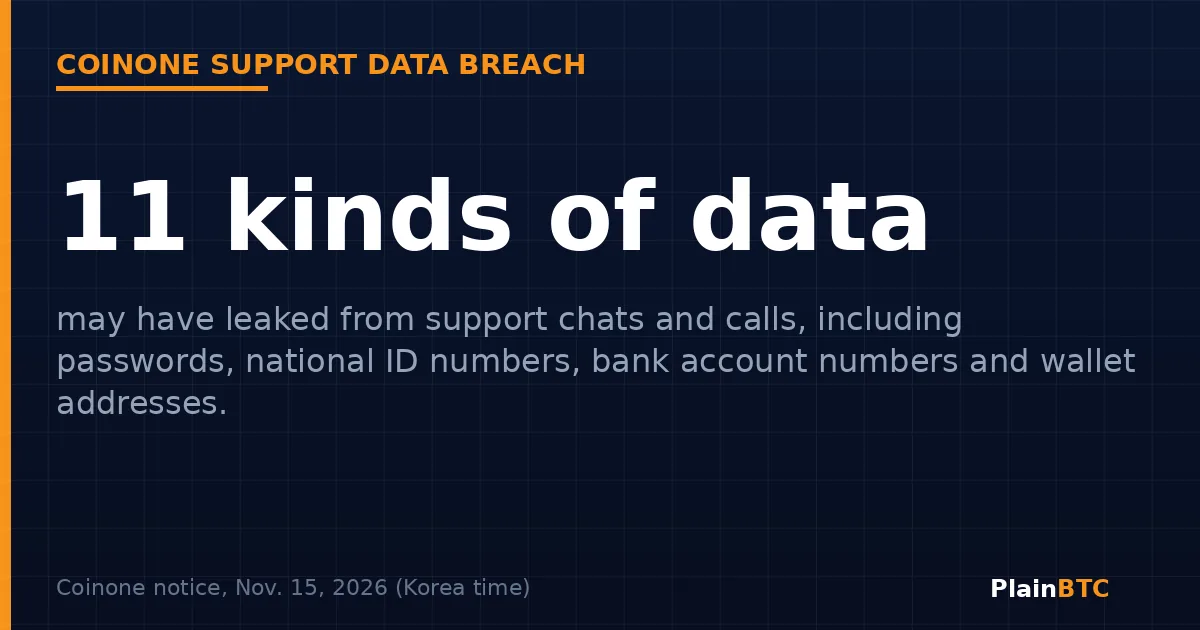
- Coinone lists 11 kinds of personal data that may have leaked, including passwords and national ID numbers.
- Customers who never contacted Coinone's support center are not affected, the exchange says.
- Coinone says its account, trading and wallet systems run separately and show no sign of a direct break-in.
What happened
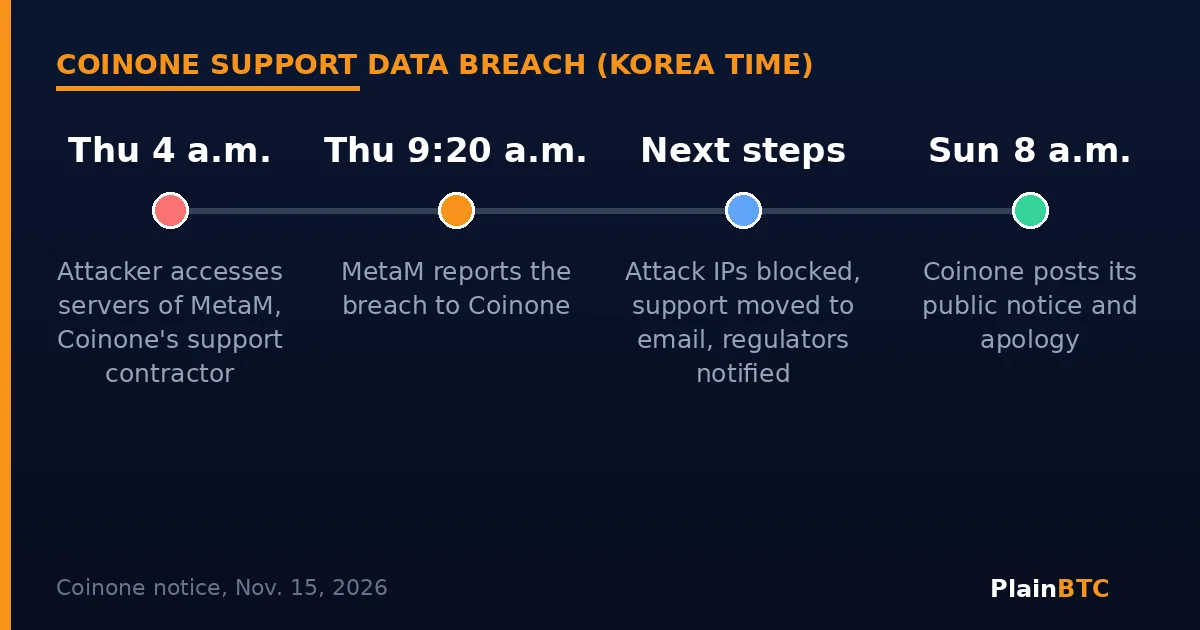
According to Coinone's notice, an outside attacker illegally accessed MetaM's servers at about 4 a.m. Korea time on Thursday, Nov. 12, and viewed or took the customer support records stored there. MetaM reported the breach to Coinone at about 9:20 a.m. the same day. Coinone posted its public notice three days later.
Once it learned of the breach, Coinone says it blocked the IP addresses used in the attack and cut off access between the support center and its systems. It switched its outsourced support to email only, stepped up real-time monitoring for unusual logins and trades, and reported the incident to the Korea Internet and Security Agency, the Personal Information Protection Commission and the Financial Supervisory Service.
MetaM confirmed signs that phone numbers and support chats in some of its systems were accessed or taken without permission, but said the data of all users was not leaked, JKN reported. Coinone did not say how many customers were affected, Cointelegraph noted.
What data may have leaked
Coinone listed every type of information that could have been exposed: the phone number used for the support call, name, email address, date of birth, bank account number, password, national resident registration number, ID card issue date, home address, crypto wallet address and transaction IDs (TXIDs). The exchange stressed that the real list differs from person to person, because each customer shared different details.
The exchange plans to send separate notices and set up a lookup page so customers can check which of their own details were exposed, The Asia Business Daily reported.
Can someone get into accounts?
Coinone says a leaked password alone is not enough. Every login requires a second step, either a one-time code (OTP) or a KakaoTalk confirmation on the customer's own phone, and login attempts from outside the official app are blocked automatically. Based on what has been found so far, the exchange says the leaked information cannot by itself be used to log in or withdraw coins.
The bigger risk is fraud. Scammers who know details from past support conversations can pose as Coinone staff in calls, texts or emails. Coinone says it never asks for passwords, OTP codes or verification codes, and never asks customers to withdraw crypto or change a wallet address. It asked users who shared a password with support to change it, along with the same password anywhere else, and to check their saved withdrawal addresses.
What it means for beginners
This breach did not touch the exchange's wallets, but it shows that your data is only as safe as the weakest company that handles it, including outside contractors. A few habits help on any platform: never type or read out your password to a support agent, use a unique password for every crypto account, and turn on an authenticator app for two-step login. Large regulated U.S. exchanges such as Coinbase offer these tools, but no platform can protect you if you hand a scammer your codes. Treat any call that mentions an old support ticket with suspicion. This is not investment advice.
What to watch next
- Whether Coinone or MetaM says how many customers were affected.
- The lookup page Coinone has promised so users can see exactly what leaked.
- Findings from South Korea's privacy and financial regulators.
- Reports of phishing calls or messages using the leaked details.
Wondering how safe big exchanges are? Read is Coinbase safe for beginners.
Bonus Partner offer
Up to$100 in bitcoin
Get up to $100 in bitcoin on River- Create a new River account through this referral link.
- Buy at least $100 of bitcoin with cash from a linked bank account.
- Get $5 in bitcoin, then up to $100 as you buy more within 180 days. U.S. only.
Referral link, we may earn a bonus. Details
Not financial advice. This article is for informational and educational purposes only. It is not investment, trading, legal, or tax advice. Cryptocurrency is volatile and you can lose money. Do your own research and consider speaking with a qualified professional before making financial decisions.
Sources
- Coinone: Notice on the personal information leak (in Korean) (Nov 15, 2026)
- Cointelegraph: Coinone warns of phishing, identity theft after customer data breach (Nov 15, 2026)
- crypto.news: South Korea's Coinone data breach may expose passwords, IDs, wallet addresses (Nov 15, 2026)
- JKN: Coinone consultation server breached, risking exposure of resident registration and bank account numbers (Nov 15, 2026)
- The Asia Business Daily: Coinone customer data leak (Nov 15, 2026)